
Everyone needs to read this and be prepared for what lies ahead.

The Next Big Silver Breakout
May 27 (King World News) – Otavio Costa: Silver miners relative to gold miners appear to be on the verge of a significant breakout.
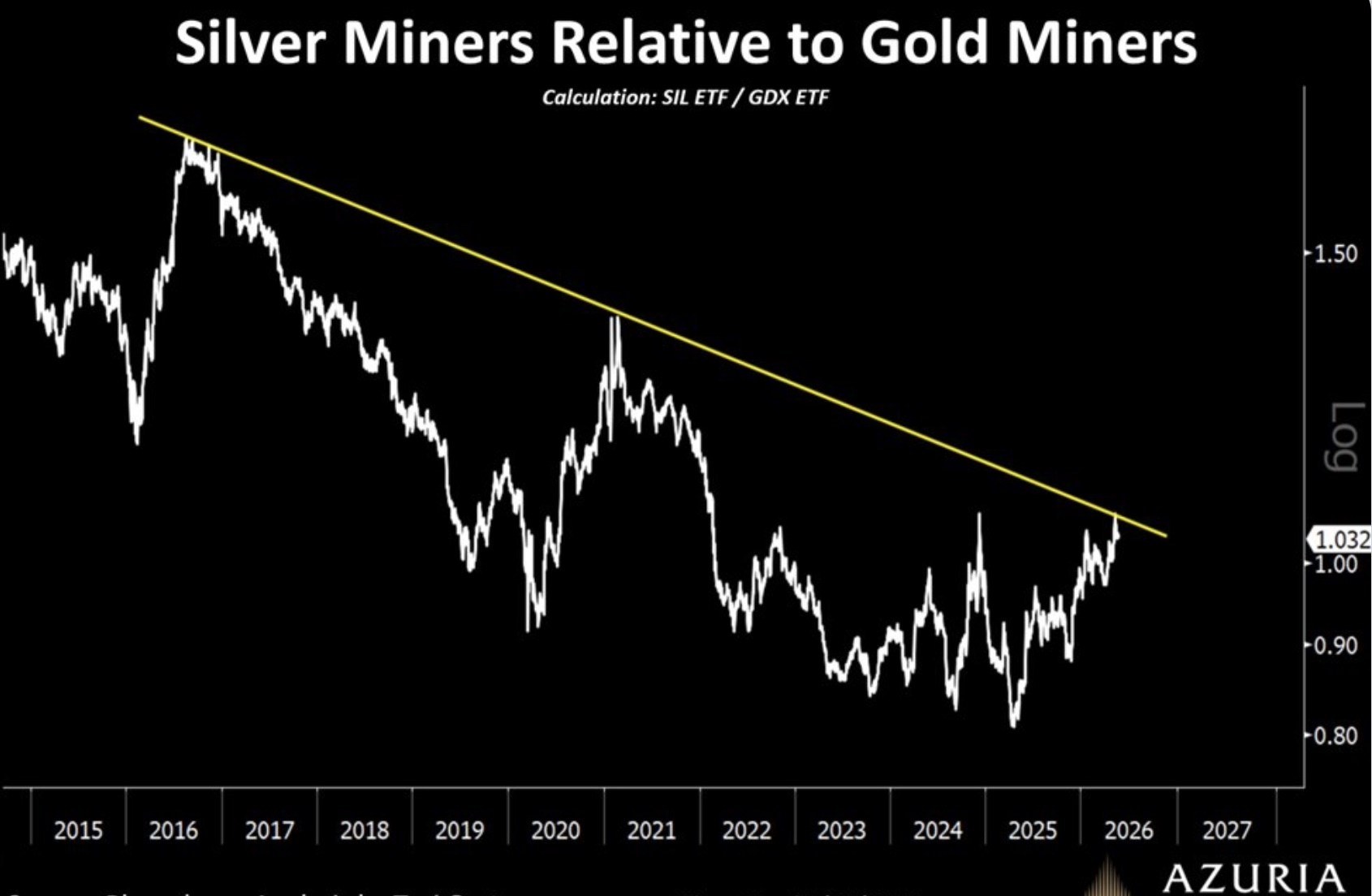
It doesn’t take a mathematician to recognize what happens when a business is selling metal for $75/oz while production costs remain closer to $15–20/oz.
These are the strongest margins this industry has ever experienced…
Listen to the greatest Egon von Greyerz audio interview ever
by CLICKING HERE OR ON THE IMAGE BELOW.

Everyone Needs To Read This And Be Prepared For What Lies Ahead
Gerald Celente: PUBLISHER’S NOTE: By the hard facts and indisputable data, the … war that the United States and Israel have launched against Iran has inflicted severe economic damage across the globe.
And remember, while President Trump said on 1 March, the day after the war began, that the war would last four or five weeks, now it is going on for nearly 13 weeks… and no condemnation of his failure.
With the Strait of Hormuz still closed and responsible for driving up oil and commodity prices that are bringing down the global economy, Trump had said this would not happen.
On 9 March Trump said, “If Iran does anything that stops the flow of Oil within the Strait of Hormuz, they will be hit by the United States of America TWENTY TIMES HARDER than they have been hit thus far.”
… he told CBS News that day that “The war is very complete” and there’s “nothing left in a military sense.”
Two days later, on 11 March he declared, “You never like to say too early you won. We won. In the first hour it was over.”
It is not over and a bad situation, we forecast will get worse and we will pay the price. Here is the latest list of Iran War fallout.
IRAN WAR WILL COST THE EQUIVALENT OF 50 MILLION JOBS, U.N. SAYS
The Iran War will reduce real labor income by 1.1 percent this year and 3 percent in 2027, which is equivalent to abolishing 14 million jobs this year and 43 million next year, the United Nations’ International Labor Organization (ILO) is forecasting.
The war has disrupted supply chains in energy, a variety of commodities, and end products, scrambled transportation, weakened tourism, and cut migrant labor, the ILO pointed out.
The Asia-Pacific region, Middle East, and Persian Gulf countries will suffer the greatest damage, more than during the COVID War, the report warned.
“Since the crisis began, labor deployments to Gulf Cooperation Council countries have declined sharply in several labor-sending economies, while repatriations are rising,” the study said. “This reflects flight disruptions, security concerns, and weaker labor demand in construction, hospitality, and transport.”
“Around 40 percent of employment in the region is concentrated in high-exposure sectors such as construction, manufacturing, transport, trade, and hospitality,” it noted.
The disruption is not short term, according to the study, but a “slow-moving and potentially long-lasting shock that will gradually reshape labor markets.”
Iran and the U.S. have claimed to want peace but continue to reject each other’s proposals.
IRAN WAR CRASHES BOND MARKETS
Bond prices fell and yields rose last week to their highest level in years, and in some cases decades, as “investors across the world are becoming increasingly concerned about the months-long conflict in the Middle East,” The New York Times reported.
The yield on the U.S. treasury’s 30-year bond reached 5.18 percent on 19 May, its highest since 2007 at the onset of the Great Recession. Japan’s 30-year bond was returning 4.13 percent, its highest yield ever. The U.K.’s political crisis made the bond debacle even worse, driving the 30-year’s yield to its highest since 1998.
Bond prices fall as investors dump them. That causes yields to rise, promising a higher return for those willing to take the increased risk associated with holding them. At the same time, higher yields raise borrowing costs for households, businesses, and governments.
“There is just a lot of fear out there right now and a collective hesitancy to step in front of the sell-off,” rates strategist Vail Hartman at BMO Capital Markets told the NYT. He cited widespread concerns that yields are not done rising.
Coupled with soaring oil prices, the bond market’s turmoil adds additional pressure to the Trump administration to settle the war in the Persian Gulf. When Donald Trump’s drastic tariff proposals roiled markets in spring 2025, he scaled back many of his sharpest increases. He faces a similar choice now regarding his demands on Iran.
The key problem remains Iran’s stranglehold on the Strait of Hormuz, a geographic bottleneck through which 20 percent of the world’s oil shipments, and large proportions of other commodities, normally move.
The strait’s closure under Iran’s threats to shipping has sent U.S. inflation from 2.4 percent before the war to 3.8 percent in April. Several new indicators show prices are still rising across the economy.
Trump had hoped to enlist the help of Chinese president Xi Jinping to press Iran to reopen the strait when the two leaders met earlier this month. Xi offered no such help, knowing that a weakened U.S. is an advantage to China, which buys oil from Russia.
Now the tumble in bonds is creeping into the stock market. On 19 May, the Standard & Poor’s 500 index lost 0.7 percent, its third decline in a row. Investors were not soothed by Trump’s assurances that Iran had only “two or three days” or “early next week” to resume negotiations. “A limited period of time,” Trump said.
The higher bond yields also are thwarting attempts to jump-start the U.S. housing market. Mortgage rates are linked to the 10-year treasury bond, which was yielding 4.68 percent on 19 May, its highest since the end of 2024.
The U.S. national average interest rate on a 30-year, fixed-rate mortgage briefly dipped below 6 percent before the war began but reached 6.51 percent on 21 May, according to data from the Federal Home Loan Mortgage Corp.
Investors increasingly expect the U.S. Federal Reserve to raise its interest rates to beat war-related inflation. Rate speculators were betting the Fed would cut a half point from its rates this year; now they have halved their expectations.
Portfolio manager Joseph Purtell at Neuberger Berman summarized the bond market’s sentiment. “There is a feeling that this is going to get worse before it gets better,” he said to the NYT.
TREND FORECAST:
As President Joe Biden should have learned in 2024, people’s experience at the gas pump and grocery store is perhaps the main determinant of how they vote in the next election.
If Donald Trump continues to talk about his gold encrusted ballroom while tens of millions of Americans are using credit cards to buy bread and coffee, Republicans are likely to lose both houses of Congress in the midterm election that is now barely 24 weeks away.
IRAN WAR HAS COST AMERICANS $41.5 BILLION EXTRA AT THE GAS PUMP
As of 19 May, American households have spent an average of $316 more on gasoline – a total of about $41.5 billion – than if the Iran War had not happened, according to calculations from Brown University.
Pump prices are up more than 50 percent since the Iran War began, rising from below $3 a gallon to more than $4.50. The U.S. national average price was $4.50 on 25 May, according to AAA.
That extra cost is more than the $40 billion Congress has allotted to the Bridge Investment Program or the $31.5 billion it is estimated to cost to upgrade the country’s entire air traffic control system, news service Al Jazeera noted.
“We could have been building the transportation infrastructure of the future if we weren’t wasting [money] on higher fuel costs associated with a war that Americans mostly don’t want,” Brown political science professor Jeff Colgan said to Al Jazeera.
The indirect cost of exorbitant fuel prices is rippling through the economy, driving up prices for everything that is manufactured or transported. U.S. inflation reached 3.8 percent in April, the highest in three years, compared to 2.4 percent in February before the war began.
The war also has raised borrowing costs. The U.S. treasury’s 30-year bonds issued earlier this month carried a 5-percent interest rate to persuade investors to buy them. The war has crashed the bond market, raising interest rates for consumers for car loans, mortgages, and other forms of debt.
SOUTHEAST ASIA STRUGGLES TO COPE WITH ENERGY PRICE SHOCK
Governments in Southeast Asian nations are moving beyond subsidizing energy bills and trying to reduce businesses and households power usage.
Earlier this month, Indonesia’s central bank raised its base interest rate by a half point as a pre-emptive measure to head off expected inflation and to prop up the currency. It was the bank’s first rate hike in two years.
Thailand, the region’s largest economy after India’s, instituted a $5.4-billion plan to offer additional aid in cash and other forms to offset spiking energy costs. Officials have warned that businesses might have to lay off workers or even shut down if the fuel crisis is not eased soon.
Indonesia, the Philippines, Thailand, and Vietnam have scaled back government travel, canceled some flights, and encouraged remote work to save gas on commuting.
The currencies of Indonesia and the Philippines are trading at record lows and are among the world’s worst performers. Both countries also are seeing investors selling their government bonds, forcing officials to raise bond yields – which reduces the amount of money the governments have to support energy subsidies for citizens.
“This is a cost-of-living crisis affecting the majority of the population,” Thai finance minister Ekniti Nitithanprapas said in a statement.
Many economies in the region already were dealing with slow growth and budgetary strains before the Iran War began.
“The risk of energy shortages is clearly growing and that’s where governments will have to find ways to dampen demand,” economist Jason Tuvey, who specializes in emerging nations at Capital Economics, said to the Financial Times.
The crisis already has set off protests.
Indonesian fishermen took to the streets to demand the government lower diesel fuel prices. The cost has risen so much that some of the fishermen can no longer afford to take out their boats.
In the Philippines, where transport drivers already have staged protests, food prices already have shot up. The inflation outlook is deteriorating, the central bank said, and it is considering an additional interest rate boost. The bank was the first in the region to impose higher interest rates because of the war.
TREND FORECAST:
Southeast Asian countries face double trouble because of the war.
First, inflation in fuel prices and, subsequently, everything else will set up several nations for Dragflation, a Top Trend 2025 in which prices keep rising while economic productivity sags.
Second, countries in which citizens already have faced shocks from the Great Recession, the COVID War, and post-COVID inflation are less willing to be patient. Government and social stability will be tested in some of these nations over the summer.
ENERGY SHOCK WEAKENS EUROPE BUT LEAVES U.S. UNTOUCHED SO FAR
Business activity is holding steady in May in the U.S. but has weakened in Europe, which is being hit harder by the loss of oil, gas, and commodities through the Strait of Hormuz as the Iran War continues.
The U.S. purchasing managers index (PMI) for manufacturing and services combined held steady at 51.7 this month. Readings above 50 indicate growth.
Analysts suggested the bump was due to businesses rushing purchases and production now to avoid what they expect to be more expensive, or a scarcity of materials and services in the future.
In contrast, Europe’s PMI slipped further into contraction, dropping from 48.8 in April to 47.5 now. In the U.K., the service sector slumped the most since January 2021.
U.S. businesses said their costs increased in May faster than at any time since November 2022 and the prices they charge rose the fastest since August 2022.
ASIA, EUROPE ALMOST OUT OF OIL, TOP ANALYST WARNS
Oil inventories are at “tank bottoms” in Asia and Europe is nearly at that level, Jeff Currie, chief energy strategist at the Carlyle private equity firm and Goldman Sachs’ former chief commodities researcher, said in a 25 May CNBC interview.
Headline inventory figures show more reserves remaining than that, he noted, but much of the oil still on hand needs to be held to ensure that pipelines and storage networks keep functioning safely. That leaves much less oil available than is being reported.
Asia is close to minimum operating levels, Currie warned. “I would say, Asia, you’re there. Europe, give it about another month. We expect Europe to start to have problems sometime [in June]. Look for July being a problem in the U.S.” when shortages might begin to appear, he added.
“All of the inventories that are drawing out of the U.S. Strategic Petroleum Reserve are being exported into Europe, so the Europeans think they have no problem because they’re getting all of this oil being imported from the United States, but that can’t continue on,” he explained.
Market pricing signals that underlying shortages are more acute than many think, Currie warned.
His comments follow those from the International Energy Agency (IEA) that the world’s oil supply could run short during the peak summer consumption period for driving and air conditioning, especially if the Strait of Hormuz fails to reopen to normal traffic.
“We may be entering the red zone in July or August if we don’t see some improvements in the situation” in the immediate future, IEA executive director Fatih Birol said earlier this month.
Currie, also the co-chairman of Abaxx Markets, agreed, pointing out that the crisis in global oil inventories gives Iran greater leverage in negotiating a peace agreement.
“Every day that goes by, Iran’s negotiating leverage compounds because oil inventories continue to drop,” he said. “Their negotiating position at this point has never been stronger in the last 47 years.”
TREND FORECAST:
Speaking at the Milken Institute over the Memorial Day weekend, Chevron CEO Mike Wirth warned that fuel shortages lie ahead, recalling the specter of cars lined up for hours at gas stations during the 1973 Arab oil embargo.
Shortages are most likely in poor nations unable to pay the even higher costs that physical shortages would bring to the world market for gasoline and diesel fuel. Shortfalls would be less dire in the U.S. because of its domestic oil supply.
Wherever shortages occur, they would be accompanied by social unrest. Street demonstrations would erupt in some countries. Political movements would arise around energy-related policies, including reopening coal-fired electric plants, investing more in clean energy, and licensing new nuclear generating stations.
Fuel shortages in the U.S, would further damage prospects for the Republican Party’s prospects in this fall’s Congressional elections.
WAR’S IMPACT WILL COME IN FOUR WAVES, AL JAZEERA SAYS
“Wars do not end when the missiles stop flying,” news service Al Jazeera said in a 21 May commentary. “They end when the structural damage they inflict on the global trading system finishes working its way through prices, contracts, balance sheets, and political legitimacy.”
By that measure, the Iran War will work its way through the global economy in four overlapping waves, the essay contended.
The first wave is the immediate surge in prices. Oil and gas costs rise and freight charges surge. However, “energy inflation is [not]…the main disruption,” Al Jazeera noted. “It is the entry point.”
Much of the world’s ammonia and urea comes from the Middle East and transits the now-blocked Strait of Hormuz, for example. “As a result, within months of a sustained gas shock, fertilizer prices follow” because ammonia and urea are key fertilizer ingredients.
Within two planting seasons, food prices will follow fertilizer prices higher; within 12 to 18 months, the cost of manufactured goods will track energy’s rise in price, Al Jazeera projects.
The second wave is the “architectural damage” to global trading patterns “that ratchet upward during a crisis and then refuse to ratchet back down afterward.”
As an example, the essay cites attacks on Red Sea shipping by Yemen’s Houthi rebels.
When the attacks began, cargo vessels rerouted around Africa’s southern tip. For oil tankers sailing from Asia to Europe, which added as much as a month and $1 million to each voyage.
When the Houthis stopped shelling, traffic could have returned to the Red Sea, Al Jazeera contends. However, it did not. Instead, shippers, their customers, and insurers had built in the fixed costs of the now-routine longer routes. “Two years on, Red Sea traffic remains way below pre-2023 levels,” it noted.
Another wave is the damage done to the global South, Al Jazeera points out. “Advanced economies absorb energy and freight shocks through fiscal cushions, reserve currencies, and diversified suppliers,” it said. “Developing economies absorb them through [cutting imports], currency depreciation, fertilizer rationing, and hunger.”
Food makes up 44 percent of household budgets in poorer countries but only 16 percent in advanced nations, the essay noted.
“This is not a market outcome,” it went on. “This is a transfer of welfare from the world’s poorest households to commodity exporters and the financial intermediaries who clear, insure, and finance the trade that survives.
“No framework agreement reverses it. The transfer simply settles into the system as a new baseline and the next shock builds on top of it.”
The fourth wave Al Jazeera sees is political. The “Arab Spring” uprisings in 2010 and 2011 were brought on by price spikes in wheat. Sri Lanka’s government collapsed in 2022 resulting from a currency crisis and unmanageable debt. In 2022 and 2023, upheavals in Pakistan came out of a combination of surging energy costs and a lopsided balance of payments.
Countries in the global South that will feel the war’s inflation most strongly are those “already operating with depleted legitimacy, narrow fiscal space, and citizens who have absorbed shock after shock since the [COVID War],” the essay warned. “Some governments will not survive.”
To minimize damage to those countries, Al Jazeera urges three actions:
∙ Transferring control of regional fertilizer and food reserves to the Organization of Islamic Cooperation or G77 frameworks to create a 12-month “food cushion” to weather disrupted imports.
∙ Creating a global South reinsurance pool to cover war-related damage.
∙ Reforming the International Monetary Fund’s treatment of war-induced financial shocks. The IMF now treats them as policy failures that require the imposition of austerity measures instead of recognizing them as “exogenous shocks [the countries] had no part in causing.”
“The architecture of recovery, like the architecture of war, is being designed by those least exposed to its consequences,” Al Jazeera wrote.
“The framework peace agreement will be the end of the war only for those who fought it. For the economies on whose backs [it] is being written, the war would be just beginning.”
JUST RELEASED!
To listen to Gerald Celente discuss gold, silver, oil as well as what surprises to expect CLICK HERE OR ON THE IMAGE BELOW.

JUST RELEASED!
To listen to Alasdair discuss what to expect next in the gold and silver markets and more CLICK HERE OR ON THE IMAGE BELOW.

ALSO RELEASED!
Look At Who Is Long Gold, Silver, Miners, Oil Fertilizer & Uranium Stocks CLICK HERE.
Huge Gold & Silver Catalysts, Plus Look At What Just Collapsed Below 2008-2009 Lows! CLICK HERE.
Celente Says This Is One Of The Greatest Dangers Facing The World Today CLICK HERE.
COLLAPSE WARNING: This Is The Scariest Chart Of 2026 CLICK HERE.
COMEX Gold & Silver Inventories Are Collapsing! CLICK HERE.
They’re Lying To You About Gold, It’s Not In A Bubble And Headed A Lot Higher CLICK HERE.
One Chart Says It All: Something Is About To Snap CLICK HERE.
Gold Miners Now Doing Largest Share Buybacks In History CLICK HERE.
Another Major Oil Price Spike Will Be Hugely Bullish For Gold & Silver CLICK HERE.
World Economy “On Borrowed Time” As Massive Oil Crisis Looms CLICK HERE.
Take A Look At What Is Now Closing In On A 30 Year High! CLICK HERE.
Expect Violent Moves In Gold, Silver, Bonds And Stocks CLICK HERE.
This Is What A Boom Looks Like! Plus A Look At Another Collapse CLICK HERE.
Rob Arnott – This Bull Market In Stocks Is Gliding Along On A Winder And A Prayer CLICK HERE.
Nomi Prins – This Pullback In Silver Is A Tremendous Buying Opportunity CLICK HERE.
Food Inflation Running Hotter Than Ever, But Look At Gold & Silver CLICK HERE.
© 2026 by King World News®. All Rights Reserved. This material may not be published, broadcast, rewritten, or redistributed. However, linking directly to the articles is permitted and encouraged.