
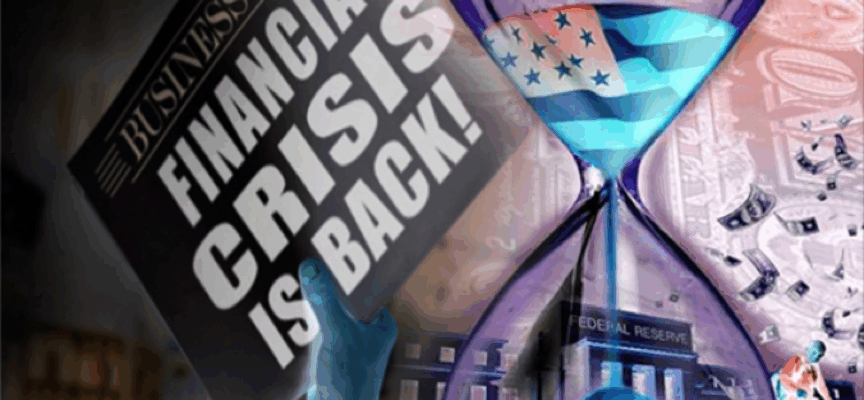
Was last week’s event really a one-day banking crisis?
Was It Really only A One-Day Banking Crisis?
October 23 (King World News) – Gerald Celente: Regional bank stocks crumbled [last] Thursday after Zions Bancorp said it wrote off $50 million in the third quarter on bad loans to auto parts supplier First Brands, which filed bankruptcy late last month.
Zions’ share price dropped 11 percent on the day.
Western Alliance Bancorp saw its share price dive 9 percent when it announced it also would take losses on loans to First Brands.
The two banks were among those that suffered the greatest damage from the collapse of Signature and Silicon Valley banks in March 2023.
Since the two banks crumbled, “regulators have been asking banks about their commercial real estate exposure, the percentage of their uninsured deposits, deposit strategy, how they are set up at the discount window, and those conversations have not changed,” attorney Dan Hartman at law firm Nutter McClennen & Fish said to The Wall Street Journal.
The banks’ damage from First Brands “doesn’t appear to be at all of that scale or magnitude,” Eric Teal, Comerica Wealth Management’s chief investment officer, told the WSJ, “but it’s sending some trepidation that the problem might be larger than first observed.”
JPMorgan Chase, the richest U.S. bank, also reported losing $170 million on its loans to First Brands.
The CEO of Jefferies, an investment bank that also was tied into First Brands, said he believed that his bank was defrauded. The company’s shares sank more than 10 percent.
The losses sparked fears that the credit market is weaker than it appears.
“Markets have been gripped by a sense of fear and panic” after last week’s bank scare, Timothy Coffey, associate research director at financial services firm Janney Montgomery Scott, confirmed to the WSJ. “There are different issues that are being conflated into one big issue about credit concerns.”
The wobble in bank stocks “is likely to continue,” he added. “This panic is like a fever. Once it enters the system, it takes a while to leave.”
Last Friday, those fears sent regional bank stocks into their worst day since Donald Trump’s 2 April global tariff announcement more than six months ago. One index of regional lenders’ stocks retreated 6.3 percent. The broader KBW NASDAQ Bank Index gave back 3.6 percent.
The losses to market valuations were aggravated by revelations that Zions is also suing the Cantor II and Cantor IV investment funds. Zion loaned $60 million to the funds, which used the money to buy distressed commercial mortgages. Western Alliance wants $100 million returned by the Cantor V fund.
Bank industry executives and analysts issued statements assuring that Thursday’s kerfuffle was only about loans related to First Brands and subprime auto lender Tricolor Holdings, which filed for bankruptcy liquidation at the same time that First Brands filed for Chapter 11 reorganization.
“The few recent corporate bankruptcies appear to be isolated cases, with the raft of bank earnings reports this week actually noting overall improving credit quality in the third quarter,” Stephen Biggar, research director at Argus Research, wrote in a note.
However, James Dimon, JPMorgan Chase executive chair, was not reassured. “I probably shouldn’t say this,” he told a BBC interviewer, “but when you see one cockroach, there are probably more.”
“While there’s clear hedging tied to fears of credit deterioration and broader contagion, it’s not yet a full-blown systemic panic,” strategist Chris Murphy at Susquehanna Financial Group, said to the WSJ. “It’s an increase in concern and uncertainty.”
“Bank stocks had stabilized over the past year,” the WSJ noted. However, last week’s one-day bank stock rout “has shown how fragile that recovery may be.”
TREND FORECAST:
Bank stocks may appear stable in the moment but they are nested in negative factors that pose greater long-term risks than markets are willing to recognize.
As we have reported, small and regional banks, which hold most of the U.S.’s commercial real estate loans, saw late-paying office loans begin to rise early last year. These banks have less diversity in their portfolios than larger institutions, making troubled loans more of a threat to them.
Loans against multifamily properties also have been under stress. The glut of apartments is being absorbed and rents are rising once again, prompting more building that will lead to another glut.
When the Fed reviewed U.S. banks’ stability over the first half of 2024, a third were rated satisfactory in all categories. The others showed deficiencies in at least one area. Governance and controls were the most frequently cited areas of trouble.
The U.S. banking system is sound, regulators have stressed. However, the Trump administration has relaxed a range of standards around banks’ performance, renewing concerns over the sector’s long-term health.
The key is banks’ bagful of commercial property loans at a time when banks are being forced to pay more interest on deposits to hold customers and still must set aside more capital to backstop bad loans.
More than $300 billion in commercial real estate loans will come due over the next three years. Many borrowers will not be able to repay their loans and many of those will not qualify to refinance their properties.
The result will be more loan defaults that, in turn, will cause some weaker banks to fail, as we forecasted.
KWN Gold Special!
In this KWN Gold Special interview listen to the man who correctly predicted that 2024 and 2025 would each be a Golden Year For Gold gives listeners an update on what to expect with gold, silver and miners CLICK HERE OR ON THE IMAGE BELOW.

Friday’s Pullback In Gold & Silver
To listen to Alasdair Macleod discuss Friday’s pullback in gold, silver and the mining stocks as well as what to expect next CLICK HERE OR ON THE IMAGE BELOW.

© 2025 by King World News®. All Rights Reserved. This material may not be published, broadcast, rewritten, or redistributed. However, linking directly to the articles is permitted and encouraged.