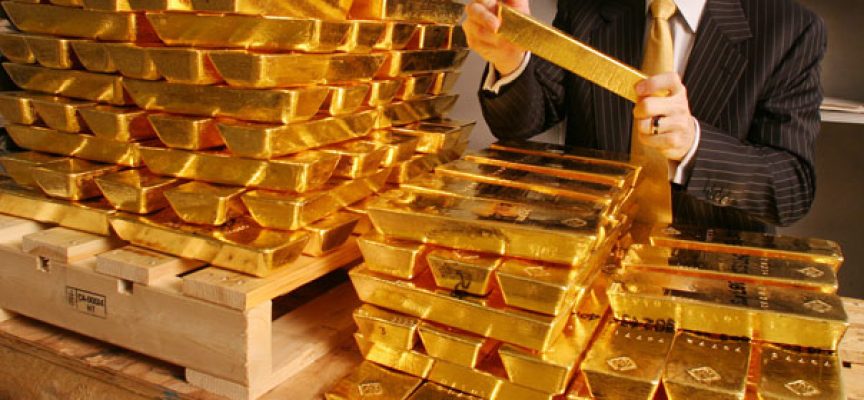
The price of gold close back above $4,700 for the first time in 3 1/2 months. Here is a look at why gold has been surging.
You Can’t Make This Stuff Up
August 25 (King World News) – Peter Schiff: Bessent said the reason Trump is only threatening secondary economic sanctions and not actually imposing them now is that he does not want to “blow up the global financial system.” Since the U.S. is the primary beneficiary of that system, no one will take this threat seriously…
Listen to the greatest Egon von Greyerz audio interview ever
by CLICKING HERE OR ON THE IMAGE BELOW.

Gold
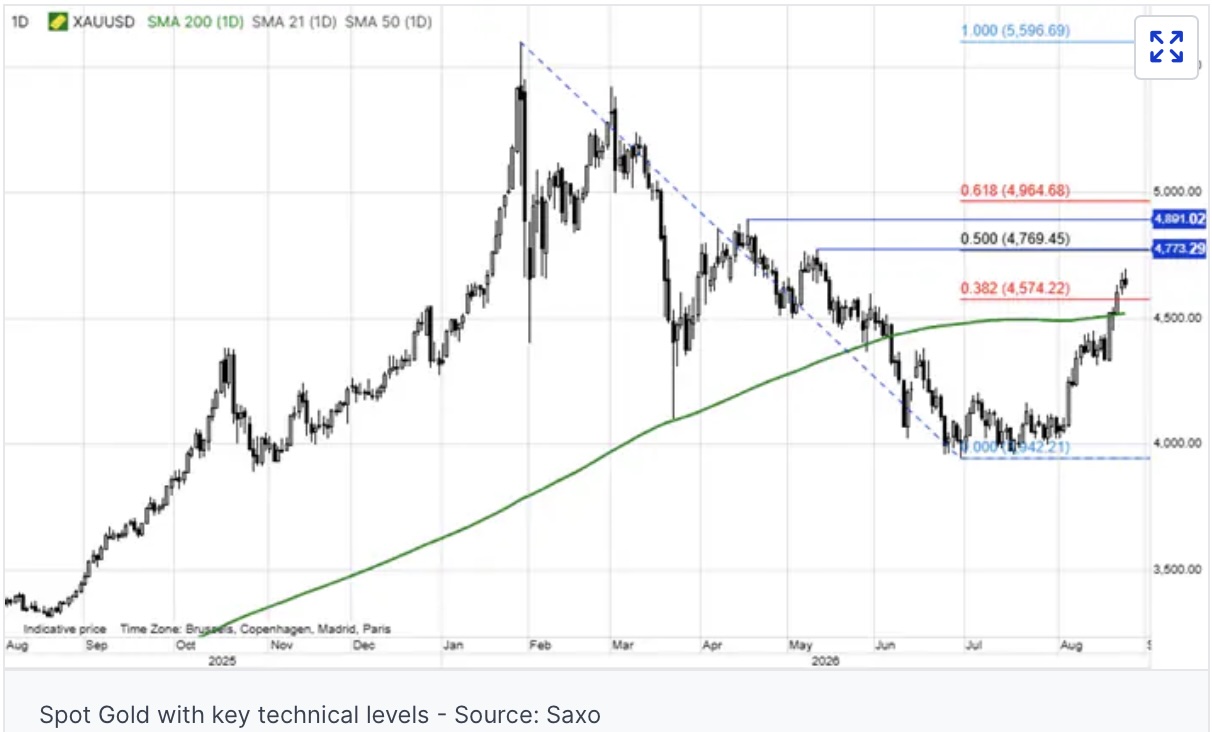
Ole Hansen, Head of Commodity Strategy at SaxoBank: Gold steadied after a four-day rally that lifted prices by around USD 350, with some consolidation emerging after the metal hit a fresh three-month high near USD 4,700 during the Asian session. Past performance is not a reliable indicator of future performance.
The limited weakness seen so far today appears primarily driven by profit-taking following the sharp run higher, together with a continued recovery in the dollar. The Dollar Index has now recouped more than half of the losses suffered following last week’s US Treasury buyback announcement. The greenback received additional support after Treasury Secretary Bessent said the US would seek to cut Iran off from the global financial system, underscoring the dollar’s central role in global trade and finance while also reinforcing its traditional haven appeal.
Investor demand has strengthened noticeably. So far this month, total gold ETF holdings have risen by around 60 tonnes, putting August on track for the strongest monthly inflow since last September, while hedge funds have boosted their net long position in COMEX gold futures to an 11-month high, and as per the chart below the highest since January if we broaden the focus to include the “Other Reportables” category. Both developments highlight how renewed momentum, a technical breakout and heightened political, fiscal and financial concerns can quickly translate into stronger demand for bullion.
The drivers that have brought traders and investors back to gold have not gone away and we believe they are likely to remain supportive in the coming months. These include concerns about US fiscal sustainability and elevated debt levels, the prospect of renewed dollar weakness, central-bank demand and continued geopolitical uncertainty. In the near term, however, attention may shift towards consolidation, with bond-yield developments and signals from the upcoming Jackson Hole symposium likely to provide direction.
The Jackson Hole symposium runs from 27 to 29 August, with Chair Kevin Warsh delivering his first keynote on Friday 28 August. The theme of the symposium is titled “Financial Innovation: Implications for Payments and Policy” – seen as likely to deliver thoughts on the potential use of stablecoins for financial system plumbing, but the market is more curious about the Fed’s interest rate policy intentions.
After such a rapid advance, an orderly rally would arguably be healthier than another sharp acceleration. It allows investors and traders to build or reduce exposure without having to chase the market higher. Vertical moves tend to encourage hurried decision-making, while also increasing the risk of positioning becoming stretched and triggering a sharper correction when momentum eventually fades.
From a technical perspective, resistance is seen around USD 4,770, an area that combines the 50% retracement of the January-to-June correction with the May local highs. Initial support is at the 200-day moving average, currently around USD 4,519, followed by USD 4,410.
Wow!
Peter Boockvar: ‘Wow’ was my reaction to reading Stan Druckenmiller’s opinion piece in the WSJ titled “Let the Bond Market Speak”, not in terms of the content as I agreed with everything he said but in the high profile, critical way he presented it. After all, he and Scott Bessent worked together for years. The piece also tells me again that Kevin Warsh is not on board either with the Treasury attempt to manipulate the long end of the yield curve. I say ‘again’ because Warsh himself has basically told us that he both wants the market to have more of a say in setting the cost of capital and he because we know he wants to shrink the size of the balance sheet and the Fed’s footprint in the market. And we know Warsh sat by the side of Druckenmiller for years prior to the new Fed Chair seat came available.
Here were some of the notable quotes from it in case you didn’t read it yet:
To the market’s immediate reaction with yields initially down and then right back up, “The market’s verdict was swift and correct: This wasn’t liquidity management, it was price management – and a mistake far larger than $4 billion suggests.”
“Treasury’s announcement gave the game away. It justified the larger operations as liquidity support in sectors with ‘consistent strong sponsorship from market participants,’ but strong sponsorship is the definition of a healthy, working market. There were no failed auctions, no dealer balance-sheet seizure, no forced unwinds, nothing resembling Treasurys in March 2020 or U.K. gilts in September 2022, the sort of genuine dysfunctional episodes that justify official action. Volatility was contained, and trading was orderly—not a malfunction but the machine doing its job.”
Believing that the long end wasn’t even fully pricing in where it should have been anyway, and that yields were actually “accommodative, not restrictive, of financial conditions” he said “The bond market wasn’t being a vigilante, as some would argue. It was being a pushover that had finally begun to clear its throat, and Treasury moved to quiet even that.”
Also this, “I have spent five decades trading on a simple premise: Markets aggregate information no committee possesses, and prices are how that information reaches decision makers. The long-term Treasury yield is the most important price in the world. It is also the only fiscal disciplinarian the U.S. has left.”
And the disease that is at the core of the problem, “Neither party will run on entitlement reform. Both have spent the past decade expanding commitments while ignoring arithmetic. Democracies don’t repair their finances because a budget office publishes a table. They repair them only when the cost of inaction becomes visible and immediate, when mortgage rates bite, when auctions tail, when the political price of a rising long bond finally exceeds the political price of touching spending.”
And to the real pushback against what Bessent did, “Every basis point of artificial yield suppression is a subsidy to procrastination. Suppressed long rates sugarcoat the interest-cost projections, shrink the apparent urgency, and let incumbents assure voters the debt is someone else’s problem. If Congress and the administration are unlikely to touch entitlements even with the market’s signal, they are certain not to touch them without one. Whatever this operation saves in basis points, it will cost multiples in delay.”
And to the timing of the operation, “Debt management that even appears to follow the political calendar spends the one asset that took two centuries to accumulate: the credibility of the Treasury market. That asset doesn’t regain its value so easily…Routine operations aren’t announced off-cycle, at double size, on the heels of the long bond’s hitting a two-decade high, with a signal that they can grow without limit. Judge an intervention by what it responds to. This one responded to a price, not to plumbing, which is exactly how the market read it, and why the effect evaporated within a day. You can’t buy your way out of a solvency conversation with liquidity tools. You can only postpone the conversation and raise the eventual price.”
Stan Druckenmiller’s bottom line, “Governments defending prices against fundamentals always lose. The only variable is how much they spend before conceding. The U.S. shouldn’t put itself on the wrong side of that trade, not with the most important price in the world, and not when that price is trying to say the one thing Washington most needs to hear: Let the bond market speak.”
https://www.wsj.com/opinion/let-the-bond-market-speak-81529d74
As I said, I agree with everything said here by Druckenmiller. I also argued last week that even if Bessent wanted to continue on this path, he picked a fight with a market that is much bigger than him and I’ll add that he’s not just pushing back against the US Treasury market but the JGB market too because we’ve seen over the past few years that what happens in the JGB market doesn’t stay in the JGB market.
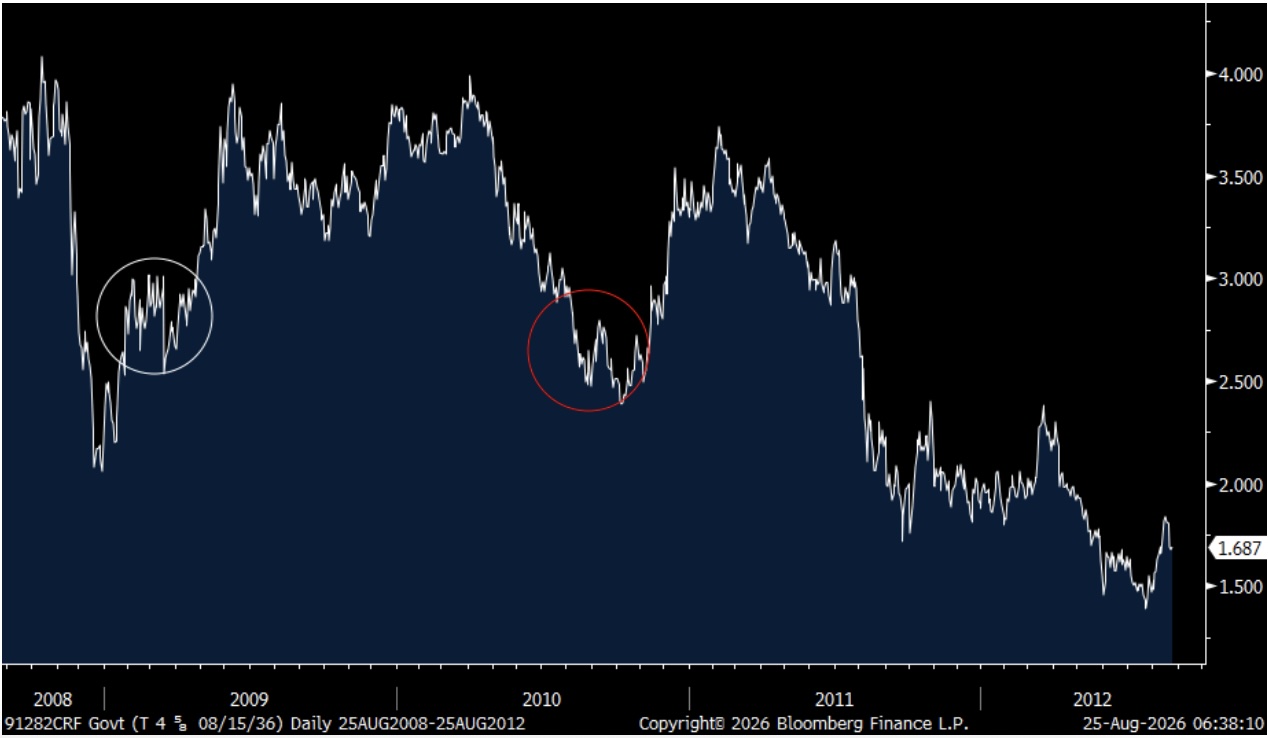
I also want to highlight this, the experience of the Federal Reserve that has the true printing press and is never limited to raising money on one hand, to finance the purchases with the other. That printing capability when turned on we know too as QE. In March 2009 the Fed began with QE1 to further suppress long term interest rates after short rates were already at zero. They also engaged in the purchases of MBS as part of this. $300 billion of US Treasuries were bought (on top of $1.45 trillion of MBS and agency debt). What did long rates do in response, they went up instead of down.
QE2 was hinted at by Bernanke in August 2010 and after long term rates initially went down in response, when the purchases of $600 billion at $75 billion per month actually began that November and lasted until June 2011, long term rates again went up instead of down. It’s no coincidence that QE3 was called ‘QE Infinity’ rather than the Fed telling us what the end dates were for QE1 and QE2 which the market targeted.
Why did rates rise, against what the Fed wanted? Because the market priced in the believed reflationary nature of the operation.
Point is, just because a public official wants to push a price in a certain direction, the market will push back if they don’t believe the fundamentals support the move.
In the chart below, the white circle is around the time QE1 began and in red is around the August 2010 Bernanke QE2 speech.
Financial Legend Rob Arnott Just Warned The US Government
To listen to this powerful interview from financial legend Rob Arnott discussing what investors should expect going forward as well as what they should be doing with their money CLICK HERE OR ON THE IMAGE BELOW.

JUST RELEASED!
To continue listening to Alasdair Macleod CLICK HERE OR ON THE IMAGE BELOW.

ALSO RELEASED!
US May Go On A Massive Gold Buying Spree Sending Price To $20,000 CLICK HERE.
This Is Why Analysts Are Now Predicting $10,000-$20,000 Gold CLICK HERE.
US Now Desperate To Manipulate Gold Price To $17,000-$20,000 Or Higher CLICK HERE.
Legend Rob Arnott Just Issued This Warning To The US Government CLICK HERE.
WHAT A WEEK: Gold Futures Hit $4,660, Silver Futures $70! CLICK HERE.
Dollar Tanks, Gold Soars, But Take A Look At This… CLICK HERE.
God Help Us: This Global Crisis Is About To Unleash An Even More Terrifying One CLICK HERE.
Gold Begins Move To $6,000 After US Treasury Bond Purchase Announcement (QE: Money To Be Printed By Fed) CLICK HERE.
Important Update: Gold, Silver, Miners And Commodities CLICK HERE.
This Just Hit Multi-Decade Highs But Here Is The Big Surprise CLICK HERE.
CRASH ALERT: US Stock Market Sees 8th Hindenburg Omen As Gold & Silver Surge CLICK HERE.
Gold Must Close Above This Key Level To Signal New Bull Market Unleashed CLICK HERE.
Nomi Prins Predicts BIS Will Make Silver A Tier 1 Asset Sending Silver Price Skyrocketing To $180 CLICK HERE.
Could The Price Of Gold Surge To $8,000 In Just A Few Months? CLICK HERE.
GOLD: McClellan Warns Investors To Expect A Lot More Downside In US Dollar CLICK HERE.
© 2026 by King World News®. All Rights Reserved. This material may not be published, broadcast, rewritten, or redistributed. However, linking directly to the articles is permitted and encouraged.