

This just unleashed another gold rush.

Game On
August 11 (King World News) – Otavi Costa: Silver miners appear to be moving ahead of silver itself.
KING WORLD NEWS NOTE: The Fact That Silver Miners Have Already Broken Out Decisively On The Upside Is Telegraphing To The Market That Silver Will Breakout On The Upside As Well
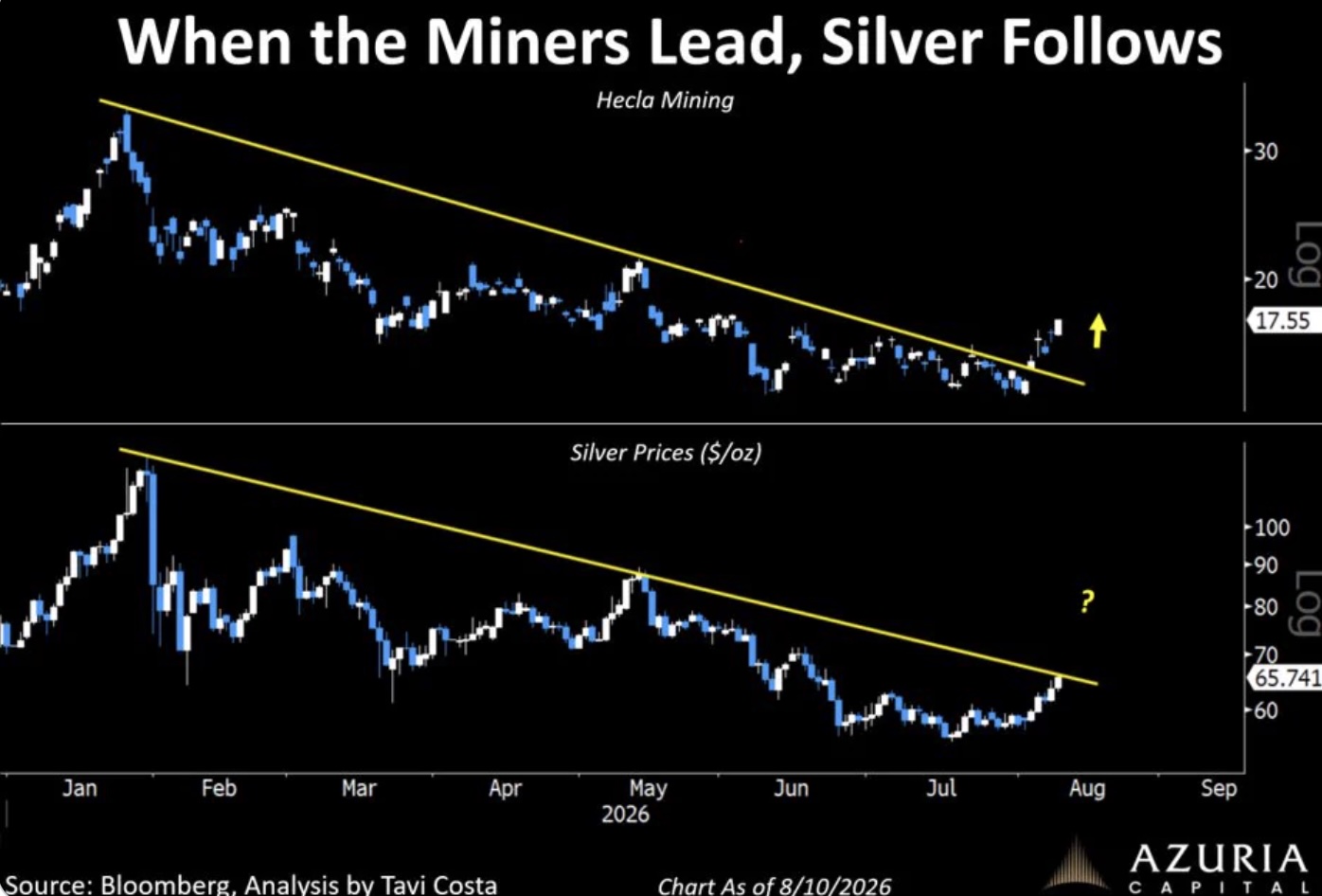
Yes, be on your toes for some normal volatility near resistance, but a breakout here could simply be a matter of time, in my view.
Game on.
This Will End In Tears At Some Point
Fred Hickey: First line from Wall Street Journal story by James Mackintosh this week titled: “Scott Bessent’s yen trade has unintended consequences for the markets”:
“The joint U.S.-Japan support of the yen is unusual. The way it is being financed is unprecedented, and adds liquidity when the punch bowl of the U.S. economy and markets is already overflowing.”
Spiking the punch bowl by adding liquidity to an out-of-control stock market mania is not exactly ‘putting the brakes on’ – as Bessent described as a better option to deal with “euphoric markets” last year.
Bessent on NBC’s Meet the Press* on Sunday, March 16, 2025:
“I’ve been in the investment business for 35 years, and I can tell you that corrections are healthy. They’re normal,” Bessent said. “What’s not healthy is straight up, that you get these euphoric markets. That’s how you get a financial crisis. It would have been much healthier if someone had put the brakes on in ’06, ’07. We wouldn’t have had the problems in ’08.”
U.S. Treasury Dept. must have been mighty concerned about fragility in the U.S. bond market and the potential impact of Japanese U.S. Treasury bond selling if they hadn’t acted to intervene.
Might have been the expedient approach – but won’t it make the problems lurking in the financial market even worse?
Listen to the greatest Egon von Greyerz audio interview ever
by CLICKING HERE OR ON THE IMAGE BELOW.

We Have Seen This Movie Before
Jeroen Blokland: Investors always believe this time is different.
The four biggest Japanese insurers are now sitting on paper losses of ¥15 trillion on their Japanese government bond portfolios. That’s nearly $100 billion.
In addition, Japan’s interest expenses will surge from roughly 2% to 10% of GDP if bond yields remain where they are today.
We have seen this movie before.
In 2022, the UK pension and insurance sector nearly collapsed after a massive spike in bond yields triggered by unfunded tax cuts, forcing the Bank of England to intervene and buy bonds on a massive scale.
In 2023, several U.S. regional banks collapsed as supposedly harmless paper losses on bonds proved very capable of causing actual defaults, forcing the FDIC to step in and protect depositors.
Both events happened less than five years ago. Spiking bond yields were at the heart of both crises.
Japan simply cannot survive with bond yields at 3% or higher without serious consequences for its financial system and government finances.
This time is NOT different.
Another Historic Gold Rush Has Just Begun
The Kobeissi Letter: Retail investors are rushing back into gold: The largest US physical-gold backed ETF, $GLD, attracted +$50 million in retail inflows on Wednesday, the largest daily inflow since March.
KING WORLD NEWS NOTE: On Wednesday The Gold ETF GLD Saw Largest Daily Inflow ($50+ Million) Since March Of This Year
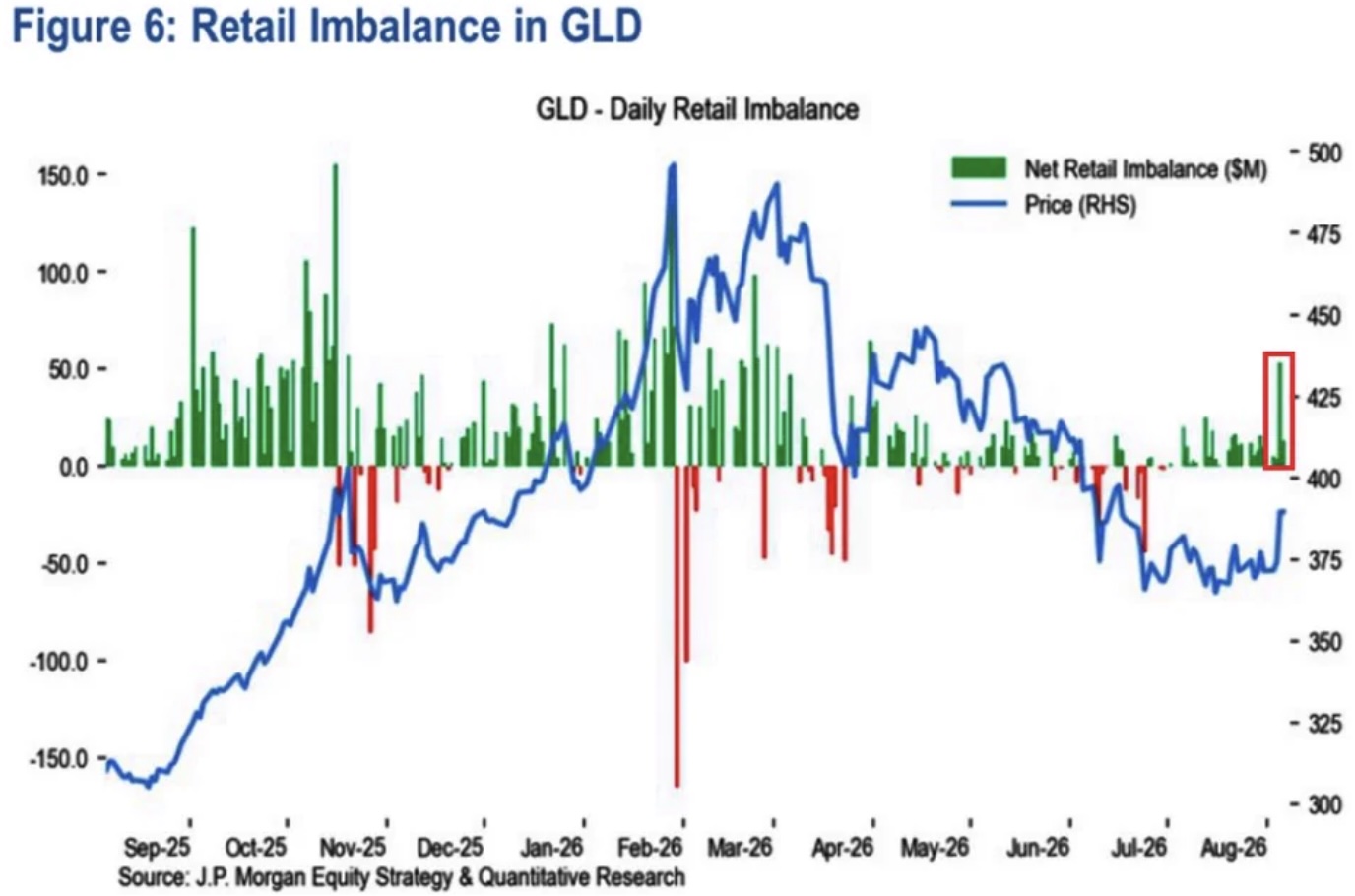
This was also twice the previous largest daily inflow recorded since early April.
Overall, $GLD attracted +$637 million in inflows on Wednesday, the largest daily inflow since June 18th.
Subsequently, the fund posted +$77 million and +$431 million in inflows on Thursday and Friday, respectively.
So far in August, investors have added +$1.4 billion to $GLD, putting the ETF on track for its first monthly inflow since February.
Investor appetite for gold is back.
Gold and silver rebound, but the real test lies ahead
Precious metals regain their footing
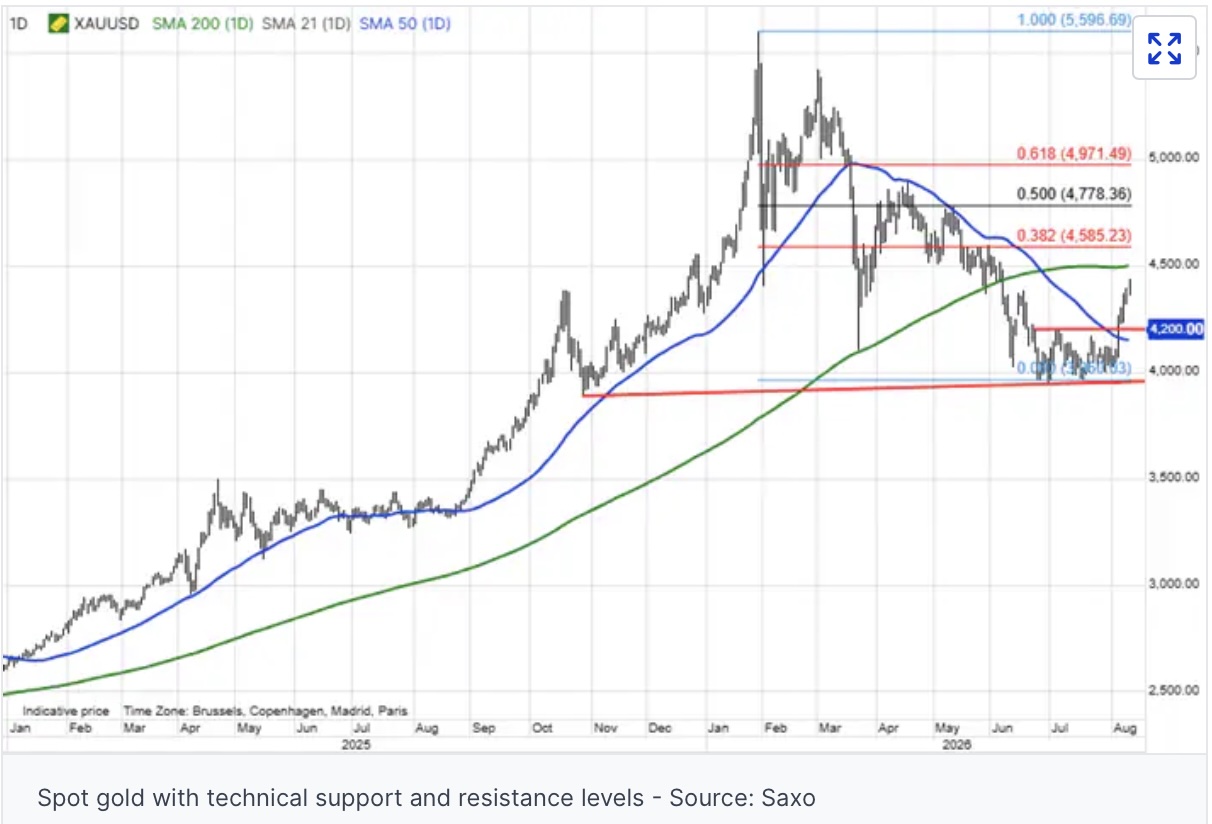
Ole Hansen, Head of Commodity Strategy at SaxoBank: The most notable development across precious metals is not the strength of last week’s rebound, but the sell-off that failed to materialise beforehand when gold repeatedly resisted selling attempts below USD 4,000…
… while silver found buyers below USD 57.
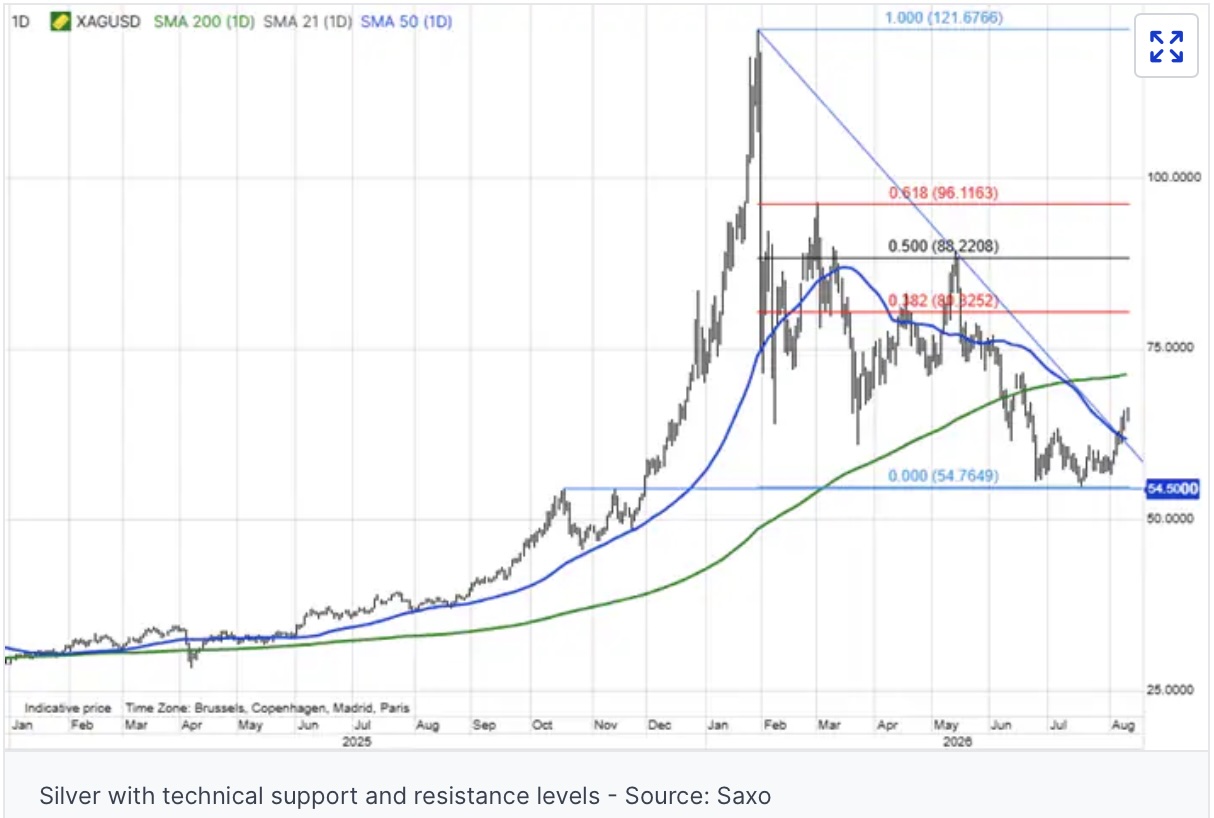
This resilience came despite several headwinds that had weighed heavily on the sector during the second quarter, including elevated bond yields, renewed concerns about US rate hikes driven by rising inflation amid surging fuel costs, a stronger dollar and subdued investment demand from Western asset managers.
Gold had fallen sharply from its January record above USD 5,500, while second-quarter losses were the largest since 2013. Yet the inability of sellers to force a sustained break below USD 4,000 increasingly suggested that underlying demand remained strong enough to absorb liquidation from more rate-sensitive investors. That resilience last week drove a 7% rebound in gold, its strongest weekly gain since January, while silver climbed back above USD 65. Friday’s weak US employment report provided the latest catalyst as it reduced expectations for another near-term Federal Reserve rate hike and helped push the dollar lower.
Fed, yen intervention and jobs data change the mood
The first important catalyst was the late-July FOMC meeting. The outcome was dovish relative to what had become increasingly hawkish market expectations rather than dovish in an absolute sense.
With higher energy prices feeding inflation concerns, markets had moved towards pricing a meaningful probability of another rate increase. The Fed instead left its policy rate unchanged with three regional Fed presidents dissented in favour of tightening, underlining that inflation concerns have not disappeared. The resulting modest reduction in rate-hike expectations took some of the wind out of the dollar’s sails, providing initial support to gold and silver.
That was followed by the highly unusual US-Japan intervention episode after USDJPY surged towards a four-decade high near 164. Japanese authorities initially stepped in to support the yen, followed by intervention from the US Treasury through the New York Fed. The coordinated action briefly drove USDJPY down towards 155, adding further pressure on the dollar and providing another supportive impulse for precious metals.
Some of that impact has since faded, with USDJPY returning towards 160, highlighting the difficulty of reversing currency trends through intervention alone when underlying interest-rate differentials remain wide. Taken together, the sequence has been supportive: a less-hawkish-than-feared Fed, a weaker dollar, coordinated yen intervention, softer oil prices and finally weaker US employment data.
Western investors begin to return
Perhaps more importantly for the medium-term outlook, there are tentative signs that Western investment demand is beginning to recover. During much of the correction, central banks and Asian investors continued accumulating gold while many Western asset managers remained sellers, deterred by rising bond yields and the prospect of higher funding costs. This created an unusual divergence between strong underlying physical and official-sector demand and weak demand from the investors traditionally most sensitive to US monetary policy.
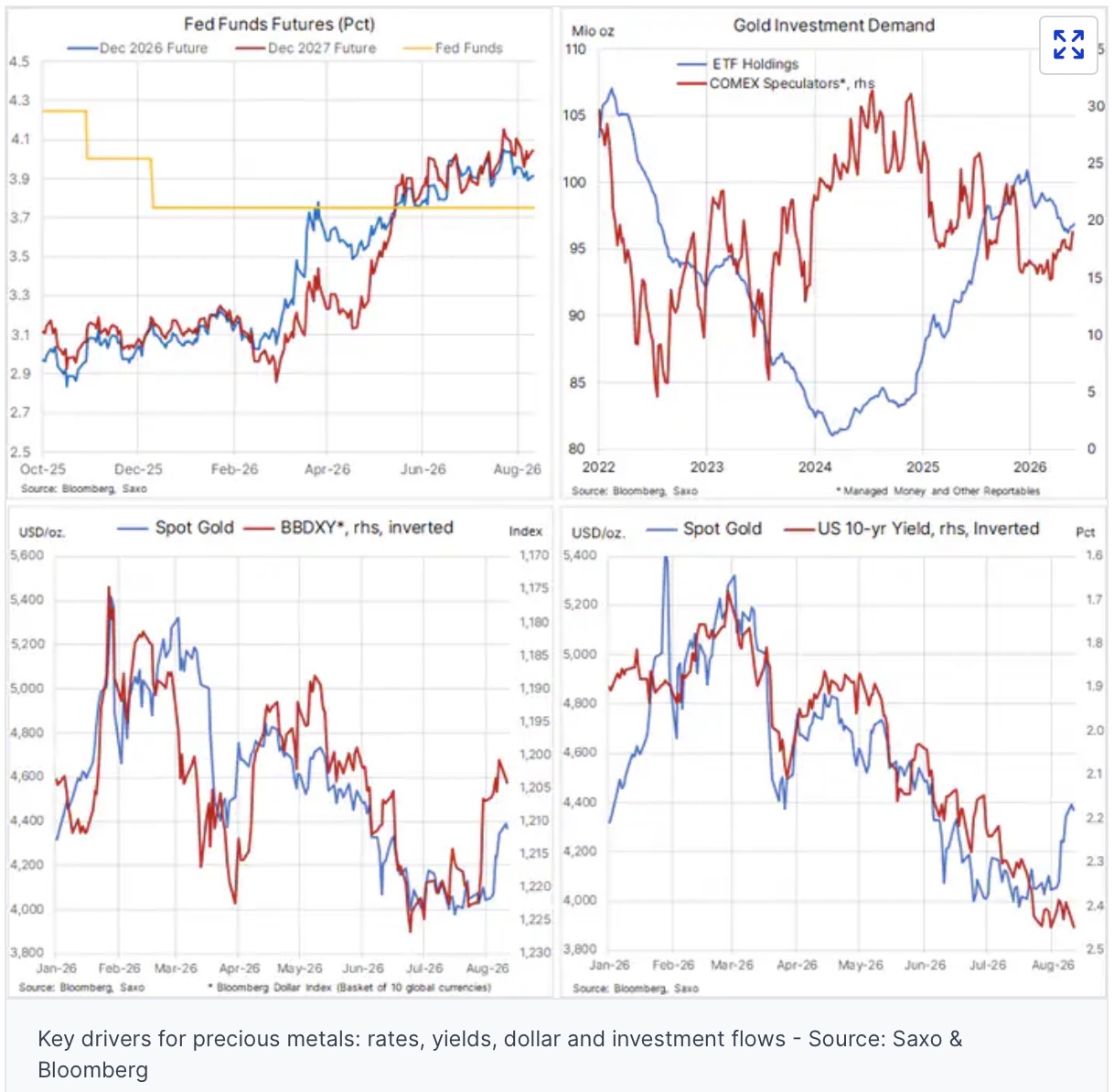
That gap may now be starting to narrow after the World Gold Council reported that global physically backed gold ETFs attracted USD 3 billion of net inflows during July, ending two consecutive months of outflows. Total holdings rose by 23 tonnes to 4,068 tonnes, with European funds driving most of the buying while North American inflows remained modest. Western investors are therefore returning, but there has not yet been a broad-based repositioning into gold, with North America still the only major region to record ETF outflows during the first half of the year.
Central banks and Asia continue to provide the foundation
While Western investment demand has fluctuated with interest-rate expectations, central-bank and Asian demand has remained an important source of underlying support. The World Gold Council reported a sharp rebound in official-sector purchases during the second quarter after an unusually weak start to the year. Although central-bank buying during the first half remained below the extraordinary pace seen during recent years, the underlying motivation for reserve diversification appears intact.
This matters because the experience of 2022–23 showed how central-bank and Asian demand can alter gold’s traditional relationship with Western financial conditions. Aggressive central-bank tightening and rising real yields failed to produce the deep and prolonged correction many Western investors had expected, partly because physical and official-sector buyers repeatedly stepped in.
A similar dynamic has helped establish a floor beneath gold during the latest correction. The question now is what happens if that structural demand is joined by a sustained return of Western portfolio flows. The combination would represent a materially stronger demand environment than the one that merely prevented gold from falling further.
Silver joins the rebound
Silver has participated in the recovery, as per usual at a somewhat faster pace given liquidity constraints but overall the outlook remains somewhat different from gold’s. The metal continues to benefit from its monetary characteristics and tends to amplify moves in gold when investment demand strengthens. At the same time, silver retains a sizeable industrial exposure, making its outlook more sensitive to global growth.
The Silver Institute expects the market to record a sixth consecutive structural deficit in 2026, while investment demand is expected to remain strong. However, industrial fabrication is forecast to decline by around 2%, partly reflecting continued thrifting and substitution in photovoltaic applications.
Silver therefore offers potentially greater upside participation should the precious-metals rally broaden, but also greater vulnerability if weaker US data develops into a more pronounced global growth slowdown.
What could still go wrong?
Despite the improving backdrop, several risks argue against becoming outright bullish just yet. The most obvious is inflation. The July Fed meeting reduced immediate tightening concerns, but three policymakers still wanted higher rates. A renewed acceleration in inflation could quickly rebuild expectations for another hike, pushing Treasury yields and the dollar higher and once again challenging investment demand for gold from rate sensitive investors.
Oil and especially fuel prices remain particularly important in this respect. Lower prices helped the precious-metals recovery last week, but the latest renewed rise following fading hopes for a US-Iran agreement serves as a reminder that the energy shock has not disappeared. A sustained oil rally could revive inflation concerns and complicate the Fed’s policy choices.
There is also no guarantee that the recent ETF inflows represent the beginning of a sustained allocation shift. July’s improvement was encouraging, but North American participation remains limited. Finally, stronger-than-expected US economic data could reverse some of the recent moves in yields, the dollar and rate expectations. The market has rapidly shifted away from expecting imminent tightening, leaving precious metals increasingly sensitive to incoming inflation and activity data.
Gold faces its next technical test
From a technical perspective, gold has, after finding support below USD 4,000, broken above recent resistance, with the former resistance area around USD 4,200 now acting as support. However, the bigger test sits around USD 4,500, where the declining 200-day moving average currently sits ahead of the 38.2% Fibonacci retracement of the January-to-June decline at USD 4,585. A sustained break above this zone would strengthen the technical outlook considerably and could open the way towards the 50% retracement near USD 4,690, followed by the 61.8% level around USD 4,860.
Conversely, a rejection at or before the USD 4,500 area would suggest that the consolidation has further to run, potentially bringing the USD 4,000–3,960 support zone back into focus. For now, the precious-metals outlook is showing signs of improving, not least underpinned by ongoing structural demand that helped prevent a deeper correction, while the macro environment has become more supportive and Western investors are showing tentative signs of returning.
That is a constructive combination, but not yet confirmation that the next sustained leg higher has begun. Gold has demonstrated where buyers are prepared to defend the market. The next test is whether they have sufficient strength to break the sequence of lower highs.
Key Points:
- Gold and silver have rebounded after successfully resisting renewed selling pressure, with gold finding support below USD 4,000 and silver below USD 57 before softer oil prices, a less-hawkish-than-feared Fed, yen intervention and weak US employment data helped trigger a sharp recovery.
- The demand picture is broadening again. Central banks and Asian investors continue to provide structural support, while Western ETF investors have started to return
- The macro backdrop has turned more supportive, but remains fragile. A softer dollar and reduced expectations for additional Fed tightening have helped precious metals, but renewed inflation pressure, another oil-price surge or stronger US data could quickly revive rate-hike expectations.
- Gold has defended the downside but has yet to confirm a renewed bull-market advance. Support around USD 4,200 is increasingly important, while the major upside test is once again focusing on the 200-day moving average, currently sitting just below USD 4,500.
Gold & Silver Breakout!
To listen to the always brilliant Tavi Costa discuss why gold is surging strongly and what to expect next from gold, silver and the mining stocks CLICK HERE OR ON THE IMAGE BELOW.

JUST RELEASED!
To listen to Alasdair Macleod discuss the historic upside breakout that just took place in gold, silver and the mining stocks as well as what to expect next CLICK HERE OR ON THE IMAGE BELOW.

ALSO RELEASED!
This Is Why The Price Of Gold Surged $430 CLICK HERE.
Silver Price Target Is Hundreds Of Dollars Per Ounce CLICK HERE.
Tavi Costa Interview: Gold, Silver And Mining Stocks Breakout! CLICK HERE.
Gold Soars As This Week’s Massive Intervention Happened Because The System Is Collapsing CLICK HERE.
Tether Now Holds 146 Tonnes Of Gold And 13.5% Of This Gold Royalty Company CLICK HERE.
This Is Why Gold Is Surging, Plus A Look At Grocery Price Inflation CLICK HERE.
Gold & Silver Soaring As The U.S. Goes Nuclear With Massive Debt Explosion CLICK HERE.
WEALTHY BOUGHT THE DIP: Gold & Silver Takedown Was Unleashed So Big Money Could Buy Cheap CLICK HERE.
Stoeferle Says Buy Gold Miners As Secular Gold Bull Market Is Intact – Global Gold Allocations Only 3% CLICK HERE.
This Is Why The Price Of Gold Has To Skyrocket CLICK HERE.
GOLD ALERT: The US Is Close To Unleashing Massive QE CLICK HERE.
This Surprise Will Be Wildly Bullish For Gold & Silver Prices CLICK HERE.
Michael Oliver Just Predicted Miners May Triple Skyrocketing Gold & Silver Prices CLICK HERE.
GOLD & SILVER ALERT: All Hell Is Breaking Loose In The Bond Market CLICK HERE.
This Is One Of The Defining Signals Of Our Time And It’s Incredibly Bullish For Gold CLICK HERE.
Oil Prices Will Soar But Gold’s 3rd Bull Move Will End The Current Global Monetary System CLICK HERE.
Gold Set To Soar vs Global Stock Market As Oil Trades Lower After Catastrophic Attack CLICK HERE.
Silver Will Trade 15x Higher If It Blows Past Its 1980 Peak vs M2 CLICK HERE.
© 2026 by King World News®. All Rights Reserved. This material may not be published, broadcast, rewritten, or redistributed. However, linking directly to the articles is permitted and encouraged.