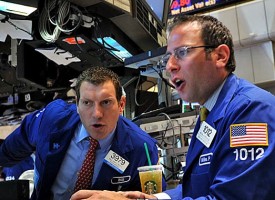

One of the greats in the business just warned that big money is preparing for a stock market crash.

March 4 (King World News) – Gerald Celente: PUBLISHER’S NOTE: When the equity markets were flying high and over a trillion dollars was being invested in the AI world, we had forecast a Dot.com Bust 2.0, and provided the hard facts and data to support our trend forecast.
As we said, trends are born, they grow, mature, reach old age and then they die. To make it clear, we said, you don’t heavily invest in the infant trend that was just born, but that’s what the money junkies were doing and that’s what the market gamblers were betting on… the infant AI babies that were born in 2022.
We had also forecast that China, and later we noted India, with combined populations of 2.8 billion vs. 343 million in the U.S., would lead the AI world and that many of America’s big AI champions would lose the AI race.
And as Gerald Celente has long stated, the business of America is war (need more proof than to see what is going on now with the U.S. launching the illegal and unprovoked Iran War?) and the business of China is business.
Therefore, as the facts prove, while Donald Trump said he wants to increase the U.S. military budget by a half trillion dollars, China is investing very heavily in AI.
The Iran War will make a very overvalued equity market crisis much worse. And what is not being reported is the growing failure of office building loans that will not be paid, which in turn will escalate a banking crisis.
Ignored for a year, as we note below, reality has finally hit The Street:
EQUITY INVESTORS ARE PLANNING FOR AI’S MARKET CRASH
What goes up must come down and a growing number of stock market players are expecting that time has come for AI stocks, The Wall Street Journal reported.
Some traders are shorting Oracle. One hedge fund boss is waiting for Nvidia’s sales to slump. Another has a private wager against OpenAI, which is not yet a public company, the paper said.
OpenAI has promised to buy $300 million in cloud services from Oracle, which dove deep into debt to build out the necessary infrastructure. At the same time, OpenAI has signed more than $1 trillion in spending commitments over the next eight to 10 years, while still burning cash and not projecting positive cash flow until 2029.
“An Oracle short is a bet against OpenAI,” chief strategist Michael O’Rourke at JonesTrading told the WSJ.
Others are coming to believe that AI’s stock values will sink under the weight of the massive debt developers and cloud companies continue to pile up, more this year than last, according to projections by Google and Meta. Amazon and Alphabet together could spend as much as $670 billion this year on AI infrastructure, much of it borrowed.
“People are more comfortable shorting [Big Tech AI firms] now because they’re sacrificing their free cash flow,” O’Rourke said. “That’s a major shift and a major risk.” He, too, is bearish on the sector.
Many investors remain torn. They fear that AI stocks will crash and wipe out their investment while fearing that, if they sell out, AI will finally begin to pay off and values will soar, leaving them out of any future wealth.
Michael Burry does not share those doubts. Celebrated in “The Big Short” for betting against the housing market in 2007 and reaping hundreds of millions of dollars, he has compared the current AI stock frenzy to the dot-com bust in 1999 and 2000, when the Internet stock bubble popped and erased an estimated $5 trillion from investors’ portfolios.
BIG TECH MAY BE HIDING BILLIONS IN POSSIBLE AI LOSSES, MOODY’S SAYS
A gap in U.S. accounting standards could give giant tech firms the ability to hide tens of billions of dollars’ worth of financial risk, analysts at Moody’s pointed out in a new report.
Limits on what companies have to disclose means the companies would not have to report the cost of renewing a data center lease or of letting a lease lapse, either of which could amount to billions in costs, Moody’s noted.
“Disclosures may not show the full picture,” the analysts wrote. “The accounting liability is unlikely to reflect certain plausible future scenarios.”
Meta, Oracle, and other companies use special legal structures in which investors pay for building data centers and own them. The tech companies then lease the buildings. Committing to a long-term lease is considered a debt by many ratings agencies.
In some of the arrangements, the companies are signing short-term leases but agreeing to pay compensation if they fail to renew the leases as they expire and if the data centers’ values decline as a result.
Accounting rules require companies to list those future lease payments as debts only if the lease renewal is 70-percent probable. The possibility of paying compensation for not renewing a lease must be accounted for only if it is more than 50-percent probable, Moody’s explained.
“A strict application of the [accounting standards] may lead many lease renewals to fall below the ‘reasonably certain’ standard,” the analysts pointed out.
As an example, Moody’s cited Meta’s data center being built in Louisiana. The building is being put up by an investor group and Meta has signed a four-year lease with the option of renewing it for up to 20 years.
Meta also has agreed to pay as much as $28 billion if the property’s value declines if Meta fails to maintain its lease over those 20 years.
The arrangement is footnoted in Meta’s latest annual report but the $28 billion is not shown on its balance sheet as a potential liability. As of the end of last year, the so-called “residual value guarantee” payments “are not probable and, therefore, no [potential] liability has been recorded,” Moody’s report said.
INVESTORS USE COMPLEX TACTICS TO HEDGE AGAINST AI CRASH
Investors remaining in the U.S. stock market despite the ongoing software selloff and impending AI stock crash are resorting to complex hedging strategies to protect their holdings.
The storm of bad news is intense. On 23 February, a long Substack post sketched a future in which AI kills jobs and slashes consumption. That sparked a selloff in software stocks.
The same day, AI developer Anthropic said its new Claude AI could replace an entire computer programming language. IBM’s share value plummeted 13 percent, the company’s worst one-day plunge since the Internet’s dot-com bust 25 years ago.
During trading on 26 February, AI chip maker Nvidia – the world’s most valuable company – had $250 billion lopped off its market capitalization at one point when investors bailed out of its shares. Nvidia’s loss sent the NASDAQ down 1.8 percent for the day.
To shelter from the storm, some investors are adopting “dispersion trades:” they bet that a particular stock will be volatile, simultaneously betting that the Standard & Poor’s index will be less so. They profit from the gap between the conflicting wagers.
Those trades are working because the S&P is trading in a tight band, varying daily by an average of 2.7 percent since this year began, “the tightest in a century outside of 1964 and 1966,” Barclays analysts wrote in a report. “This calm at the macro level masks wild gyrations at the micro level.”
The spread between the relatively sedate S&P and individual stocks’ gyrations is the widest since 2009 during the worst of the Great Recession, Barclays noted.
“The fast-money accounts like hedge funds are much more active, but you’re also seeing the application of this [strategy]” by asset managers and pension funds, Barclays strategist Anshul Gupta told the Financial Times.
“Institutional client hedging has been relentless” in the face of “the deluge of negative catalysts for equities” and the continuing “game of market doom whack-a-mole,” Charlie McElligott, Nomura bank’s director of equity derivatives, said to the FT.
Investors are fleeing stocks of firms in commercial real estate, fearing that AI startups coming into the industry will slash service firms’ advisory income and shrivel related businesses such as appraisals.
“The threat is the 28-year-old broker with AI who can deliver in two hours what used to take you two weeks,” Francis Huang said to The Wall Street Journal. Huang is a co-founder of Apers AI, which offers AI systems that advise on allocating capital in commercial real estate investments.
“Nothing less than the industry’s future is at stake,” the WSJ declared.
CBRE Group, the world’s largest commercial real estate services firm, reported record revenues, record profits, and earnings that beat expectations in its most recent fourth quarter. The same day, its share price fell 8.8 percent after diving 12 percent the week before.
CBRE’s competitors Cushman & Wakefield, JLL, and Newmark also have seen their market values plunge, “wiping away tens of billions of dollars in market capitalization for the sector,” the WSJ noted.
The appraisal industry already has taken a hit in other countries, where AI has cut revenue per appraisal but has boosted the profit per job.
Industry leaders sought to quell investors’ panic, pointing out that AI will cut operating and research costs while bringing new business as AI data centers build out and draw service businesses to their vicinities.
Even in a bad market, commercial real estate deals typically involve complex negotiations that require a combination of in-depth local market knowledge and human “soft skills” that AI is unable to duplicate, industry executives pointed out.
“Top brokers walk the floors of countless buildings, swap insights over bad coffee, and turn years of schmoozing into multi-million-dollar commissions,” the WSJ noted.
While those brokers and businesses might survive, smaller companies making standard kinds of sales and relying on public information are in the greatest jeopardy, insiders acknowledged.
The commercial real estate business is already reeling from the Office Building Bust, one of our Top Trends in 2023. Remote and hybrid work has cut down demand for office space, leaving as much as a quarter of U.S. office properties in jeopardy. With hundreds of billions of dollars in loans on those buildings coming due, many will not qualify to be refinanced.
Stock prices of SL Green and other major commercial office landlords are down at least 15 percent so far this year alone.
Also, spending days piling up research to take into a client meeting over a major deal will become a bygone human skill, insiders told the WSJ.
“AI doesn’t replace you,” Huang explained. “It arms your competition with the ability to build relationships faster than you can maintain yours.”
AI SHOOTS DOWN EUROPEAN ASSET MANAGERS STOCK PRICES
The release of financial technology firm Altruist’s new AI tool has whacked the share prices of major European asset managers, the Financial Times reported.
The tool can analyze the likelihood and tax consequences of various possible future scenarios for investors, such as timing one’s retirement or selling a property at a particular time.
Investors were spooked that the AI’s ability to make those judgments may render some asset managers’ advisory services obsolete.
Major European firms including Lombard Odier, St. James Place, and Schroders have reassured investors that the companies are making greater use of AI to help human experts sharpen their insights.
Bots cannot replace the specialized expertise and human-to-human interaction that the firms can offer, they added.
However, asset managers that fail to embrace AI fully and with speed “may well be replaced by those that do,” St. James Place CEO Mark FitzPatrick said to the FT. His firm manages about £220 billion for clients.
Instead of replacing human advisors, AI “will put their work on steroids,” making them more productive, he added.
His company’s 5,000 advisors already are using AI to record conversations with clients and outline possible recommendations for them, he noted. The firm’s internal AI answers advisor’s technical questions, which improves “quality and speed of service” as skilled humans make final judgments about allocating clients’ funds, he said.
“Every simple activity” that humans now do, such as back-office processes or the paperwork to enroll a new client, is being given to AI, Geoffrey de Ridder, Lombard Odier’s chief technologist, explained to the FT.
“We can now do things 20 to 50 times faster,” he said.
AI’s threat to the industry is focused on firms serving the “mass affluent,” Richard Oldfield, Schroders CEO, said in an FT interview. Those companies “will use AI to replace advisors in areas where that makes sense.”
Off-the-shelf financial “guidance” is “eminently disruptable by AI,” one fund manager told the FT. However, “full-blown financial advice” – the kind reserved for the very rich – “is a people business. Individuals find it hard enough to trust humans to advise on large sums of money, let alone an algorithm.”
DOUBTS ABOUT THE SOFTWARE INDUSTRY’S FUTURE PERSIST
Business software companies were a key part in the bull market’s run-up after the COVID War, thanks to their elevated subscription prices and minimal need for infrastructure.
However, the entire software sector tanked January as investors saw new software tools that can do what conventional computer programs do. Stocks of software companies including Adobe, Microsoft, and Salesforce sold off. Salesforce’s market value dove 27 percent, Microsoft’s 28 percent. Dozens of companies were impacted.
The panic selling has passed, but investors still wonder if software developers have a future in an AI world and continue to move out of the sector.
Workday, which makes HR software, has fallen 35 percent in 2026 and Intuit, which makes tax and financial software, has become the Standard & Poor’s 500’s worst performer, plunging 40 percent since the end of December.
The State Street SPDR S&P Software and Services exchange-traded fund (ETF) that follows 140 companies, is down 16 percent this year and has lost a quarter of its value after peaking last fall.
Companies in the ETF are trading at about 19 times their 12-month forward earnings, less than half the 44 times their prices reached in 2022. Currently, the S&P is pricing at about 22 times forward earnings.
Companies in the ETF have collectively lost $1.5 trillion just this year. AppLovin, Intuit, Microsoft, Salesforce, and ServiceNow each have shed at least $50 million since 1 January.
The sector’s slump is also dragging down private equity, which invested heavily in the software industry for a dozen years. Investments slowed as this decade began but private equity firms still hold positions in dozens of software businesses.
Share prices for Apollo Global Management, Ares Capital Management, and Blue Owl Capital have all slid downhill along with the software sector’s overall market value.
Software companies make up about 13 percent of the investment-grade bond market, but a somewhat larger proportion of loans made are from the private credit industry, which is faltering because of fears that it has made too many loans to companies that might be unable to repay.
Again, we maintain our forecast for a continuing rise of defaults among software providers and that the worst is yet to come.
US Strike On Iran Will Lead To Global Depression
To listen to Gerald Celente discuss his prediction for a global collapse and what investors should be doing to protect themselves and their family CLICK HERE OR ON THE IMAGE BELOW.

ALSO JUST RELEASED!
To listen to Alasdair Macleod discuss exactly what is happening in the gold, silver, commodity and currency markets CLICK HERE OR ON THE IMAGE BELOW.

ALSO RELEASED!
The Next Big Bull Market Is Already Underway CLICK HERE.
Expect Historic Moves In Oil As The War With Iran Continues, Plus A Look At Gold & Silver CLICK HERE.
Colombo Says, Despite Volatility, Silver Price Headed To All-Time High CLICK HERE.
Get Ready For More “Transitory” Inflation After Iran Attack, Plus A Look At Gold Miners CLICK HERE.
The Dollar Is Going To Zero And It Will Take All Fiat Currencies With It CLICK HERE.
Gold Price $5,250 As Silver Futures Hit $94, But Look At This… CLICK HERE.
The Latest From The Big Boys On The Gold Market CLICK HERE.
Celente Issues Gold Price Prediction For 2026 CLICK HERE.
Michael Oliver – A New Bull Market Is About To Be Unleashed On The Upside CLICK HERE.
Another Gold Record, Yet Another Gold Catalyst Plus A Massive Short Surprise! CLICK HERE.
Michael Oliver – This Will Be The Biggest Breakout Of The Gold Bull Market CLICK HERE.
Important Update As Gold Price Surges Above $5,200 & Silver Hits $87 CLICK HERE.
US Strike On Iran Could Unleash World War III CLICK HERE.
Gold Price Rebounds As Oil Price Surges Strongly CLICK HERE.
Michael Oliver – Historic Breakouts Will Now Send Gold & Silver Prices To Levels That Will Shock The World! CLICK HERE.
© 2026 by King World News®. All Rights Reserved. This material may not be published, broadcast, rewritten, or redistributed. However, linking directly to the articles is permitted and encouraged.