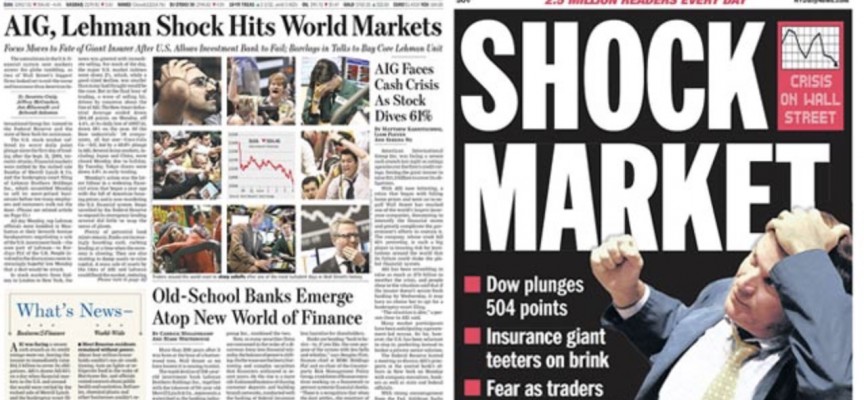
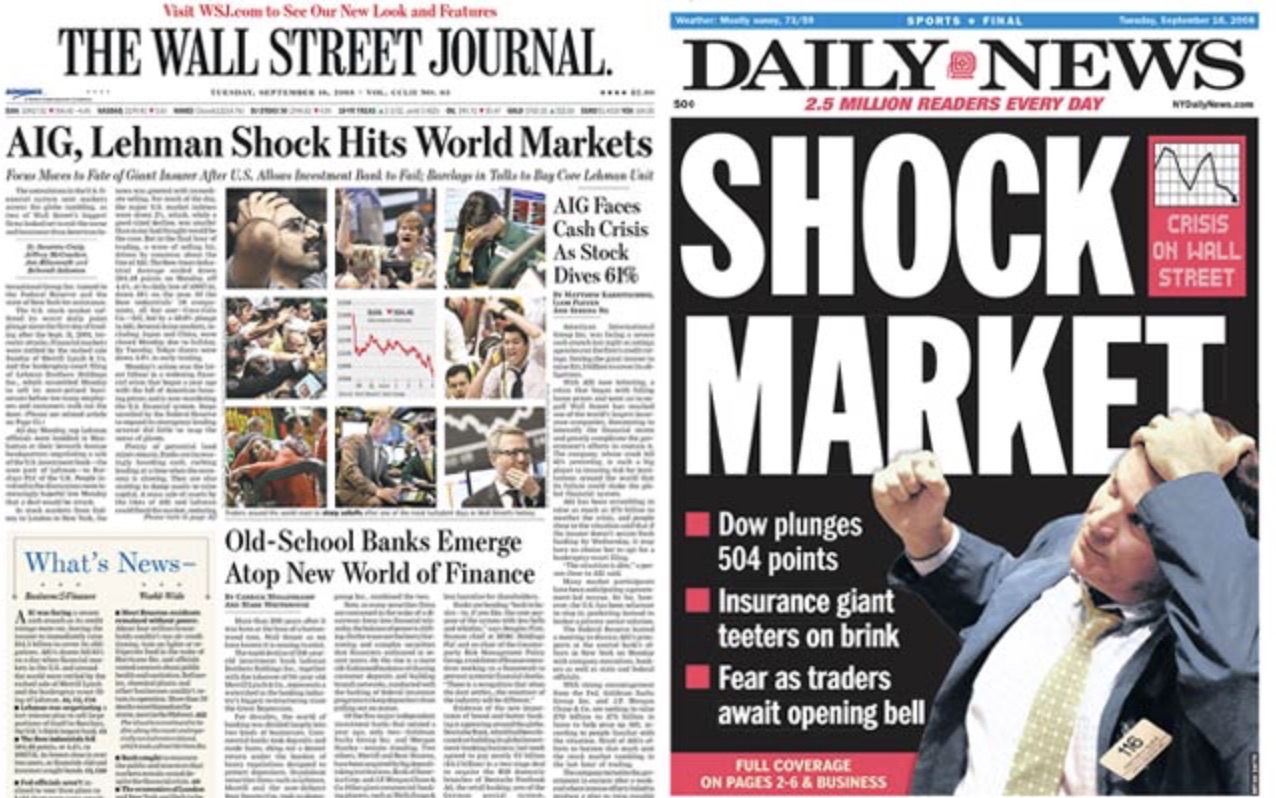
As we kickoff trading in the final two months of the year, the Fear Index is now approaching levels last seen prior to the 2008 global collapse which shocked market participants and set off a historic panic.
Fear Index
November 3 (King World News) – James Turk: I’d like to provide KWN readers with an update on my Fear Index, Eric. I developed the Fear Index back in the 1980s and written an extensively about it over the years because of its proven reliability.
It’s a simple formula. Multiple the US Gold Reserve times the gold price and divide the result by M2, the quantity of dollars. I also do this calculation for global central bank gold reserves and total fiat currencies in circulation, which comes up with a similar result. I generally focus on the dollar because it remains for now the major world currency and dominant monetary force.
Back in August 2024, I presented to KWN readers the long-term chart of the Fear Index. I had an inkling that an uptrend was beginning. And indeed, it did.
So for months now the Fear Index has been telling us that there is financial trouble ahead. In other words, it looks like the boom is ending and a bust is near.
These boom-bust cycles are recurring events. Banks lend too much money and overextend themselves during the good times. But the level of debt at some point inevitably becomes unsustainable, leading eventually to a contraction.
When that happens banks not only stop lending, they start cutting credit lines to borrowers and even demand loans be repaid. This struggle by banks to de-leverage and reliquify causes the crisis because not all banks are able to get their clients to repay. A lot of bad loans made during the good times become unrepayable during the bust.
There are two key fundamental points underlying the Fear Index.
1) When people become nervous about the state of the economy, banking system, currency, and other monetary or financial matters, they act by moving their purchasing power out of dollars by buying into tangibles like gold and silver or near-tangibles like stocks of companies operating businesses involved in tangibles. Examples are miners, oil and agribusiness companies. While a rising Fear Index reflects growing concern about the health of banks and the currency, a falling Fear Index reflects growing confidence in them.
2) Then there is the accounting principle that balance sheets must always balance. To explain, currencies are liabilities of banks, or in other words, customer deposits are purchasing power that banks owe to their customers. These bank liabilities have value because bank assets are perceived to have value, but views change. As investors begin to recognize that a lot of bad loans made during the good times will not be repaid during the bust, the Fear Index begins climbing to achieve balance between assets and liabilities. It does this because a rising gold price increases the value of gold reserves held by banks, which thereby offsets the decline in the value of other bank assets, namely, their loan book.
During the bust and a rising Fear Index, central bank actions lead to two alternatives – central banks cause deflation or they cause inflation. Central banks are the problem.
In the 1930s Great Depression, thousands of banks failed, and their depositors suffered the consequences of lost purchasing power owed to them by the bankrupt banks. With less banks, the quantity of dollars collapsed by 30% causing a deflation. Ever since, when banks are in trouble – like 2008 – they are bailed out by Federal Reserve money printing to avoid deflation, and the result has been inflation.
I’ve been through a few of these boom-bust cycles in my lifetime, and even younger people may recall the 2008 financial crisis or heard about it from family and friends who lived through it. And as bad as that crisis was, others have been worse.
Right now the Fear Index is approaching the level reached when the 2008 crisis was wreaking havoc around the globe.
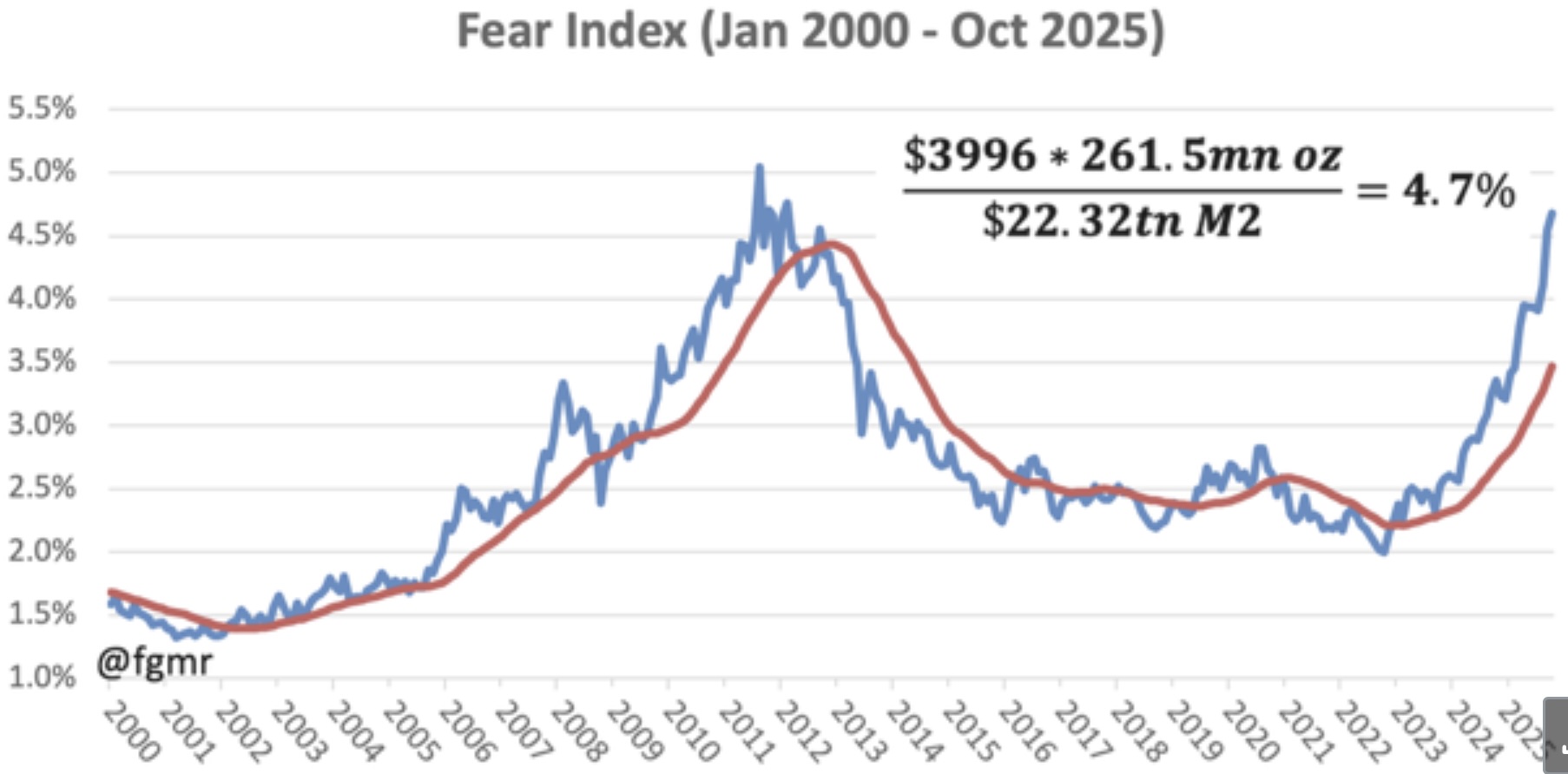
The Fear Index back then peaked at 5.05%. It’s now at 4.68%, more than doubling from its 2.0% low in October 2022. It’s risen 1.5X from my August 2024 article.
There is of course no guarantee that the uptrend will continue, but if it does, the odds suggest another banking crisis will in time unfold. For that, Eric, we need to be prepared just in case.
One way to do that is to protect your purchasing power by holding physical gold and physical silver. In other words, be sure you move some purchasing power out of fiat currency and the banking system into the precious metals.
Just Released!
John Ing is a man of great wisdom, and he discusses exactly what his contacts are sharing with him as well as where the price of gold, silver and the miners are headed and you can listen to it now by CLICKING HERE OR ON THE IMAGE BELOW.

To listen to Alasdair Macleod discuss what is happening with gold, and especially silver and the mining stocks CLICK HERE OR ON THE IMAGE BELOW.

© 2025 by King World News®. All Rights Reserved. This material may not be published, broadcast, rewritten, or redistributed. However, linking directly to the articles is permitted and encouraged.