With so much chaos unfolding across the earth that has been the catalyst for one of the most turbulent market environments in history, this is one of the most fascinating articles on gold that you will ever read.
April 10 (King World News) – King World News was given permission by Dr. Marc Faber at the Gloom Boom Doom newsletter to republish the following article from Jan Baltensweiler at VON GREYERZ: On last year’s conference tours, from Colorado to Frankfurt, Vienna and Prague, renowned gold expert Ronald-Peter Stöferle often encountered the same question:
“Are we already too late to buy gold?”
The question itself says more than any dataset. It reveals a simple truth: most investors were never really involved in the move to begin with.
Gold has reached new highs, yet the Western investment community remains largely absent. Prices continue climbing, but participation is limited. This is precisely the moment to reconsider what real value looks like.
The Quiet Apathy
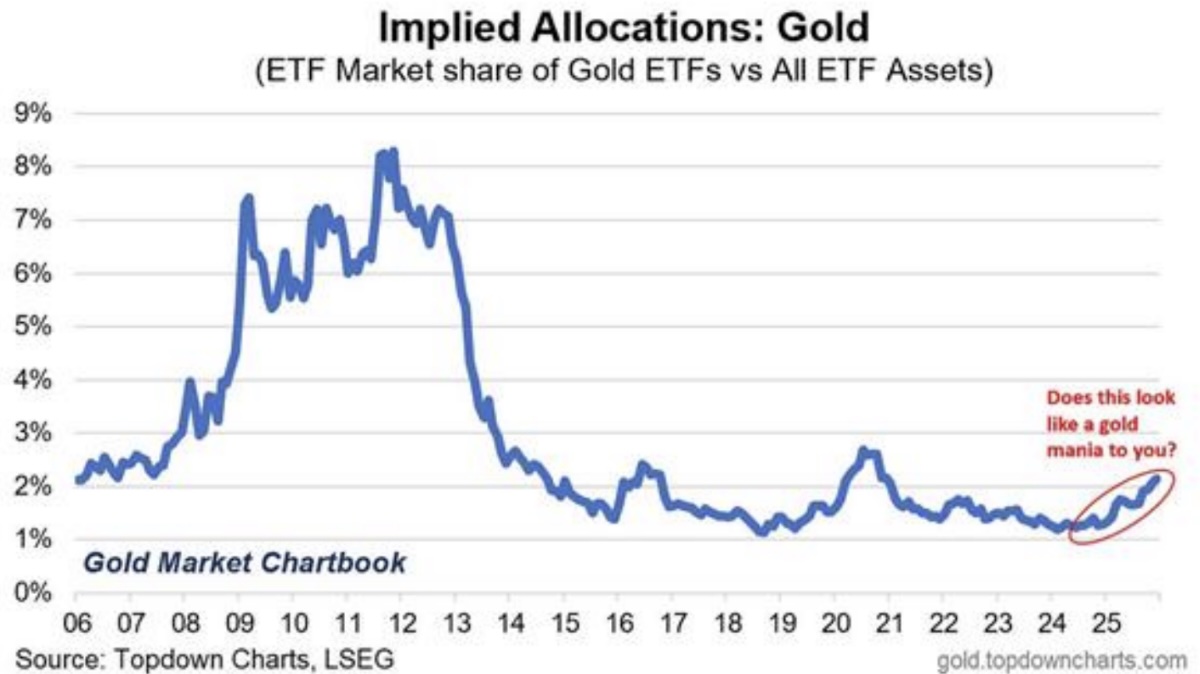
Global ETF holdings sit only marginally above their 2020 levels. Capital continues flowing into technology, equities and fixed income, while gold remains largely ignored.
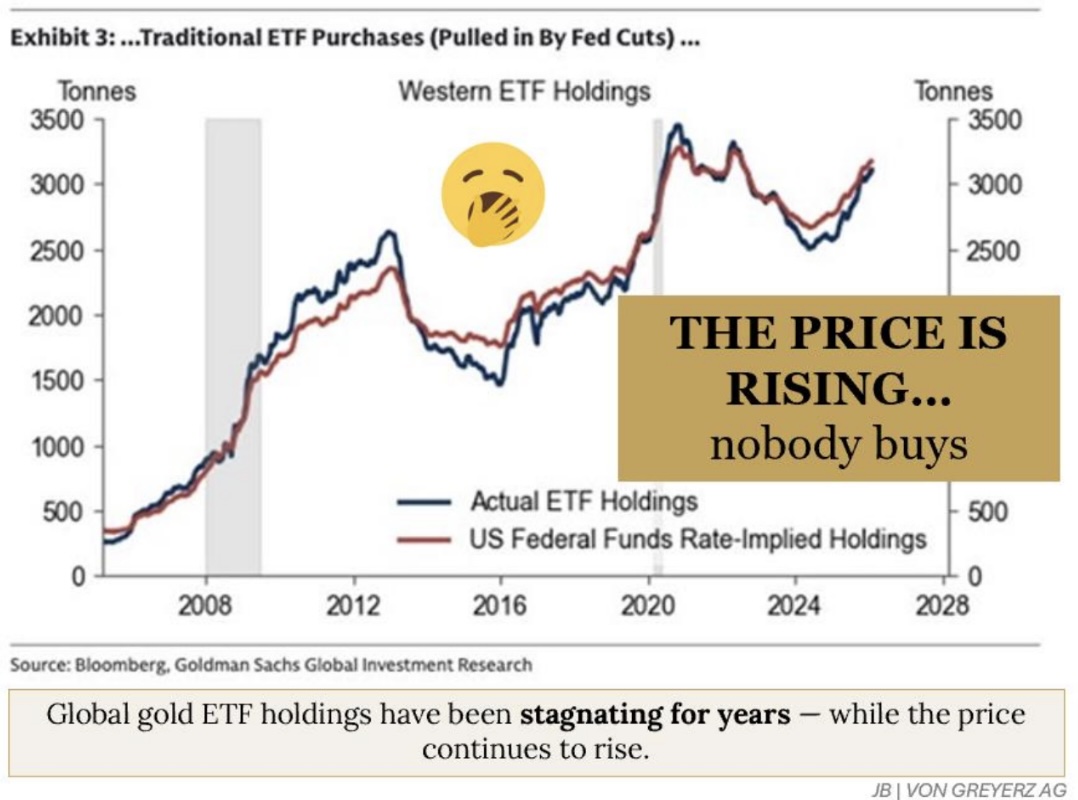
The paradox is obvious: gold rises even as many Western investors sell. The explanation is simple, price discovery is no longer dominated by the West.
Economist David Rosenberg noted last year that the gold-to-S&P 500 ratio remains well below its long-term average.
“Does this look like a bubble to you?”
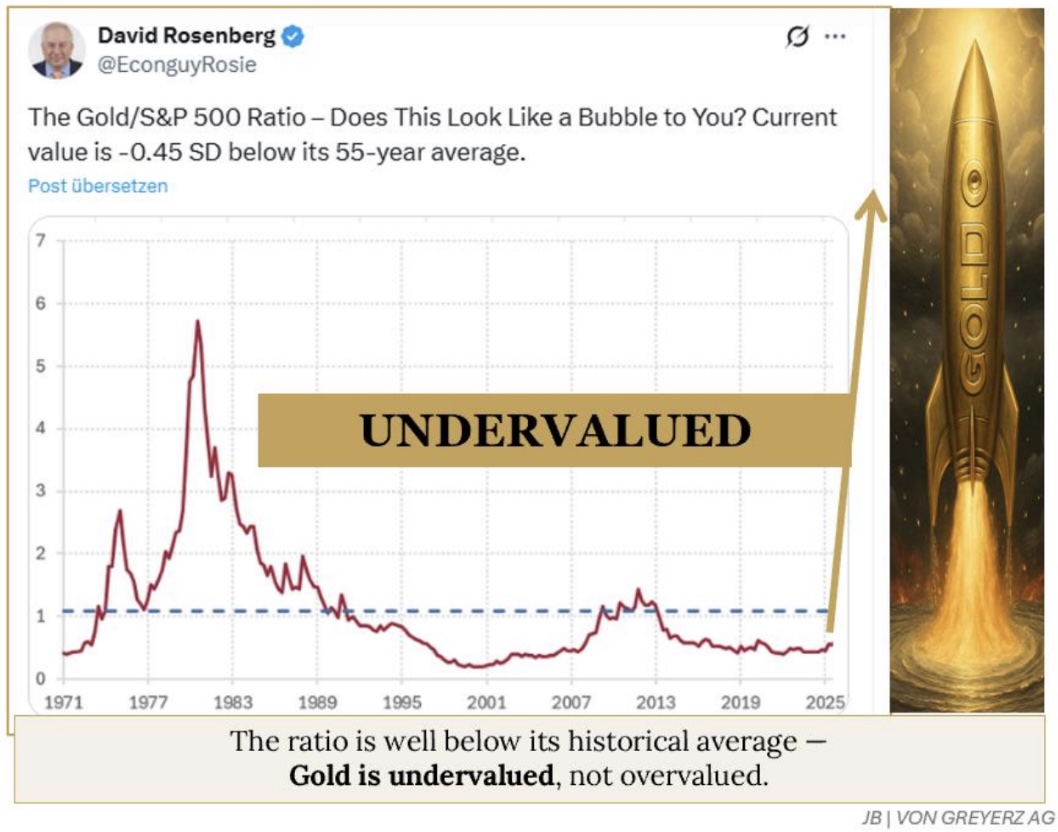
Gold today is not a speculative mania. If anything, it represents a quiet return to real value in a world driven by multiples and momentum.
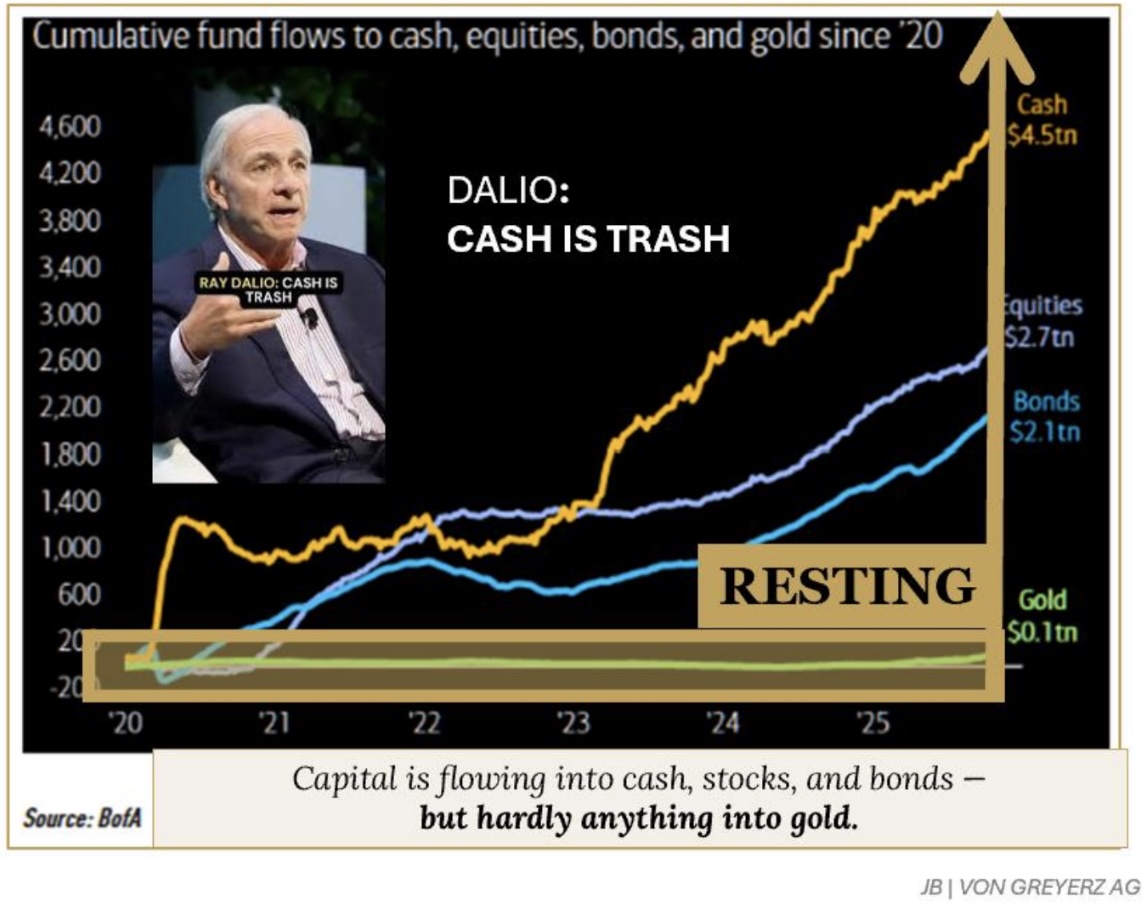
Since 2020, trillions have poured into money-market funds, bonds and equities. Gold has attracted only a fraction of those flows. Investors continue chasing returns rather than safety, although market cycles rarely move in one direction forever.
The ETF market share data also shows gold ETFs remain a small slice of total ETF assets.
The East Is Buying What the West Ignores
While the West focuses on growth, leverage and innovation, the East is accumulating tangible assets.
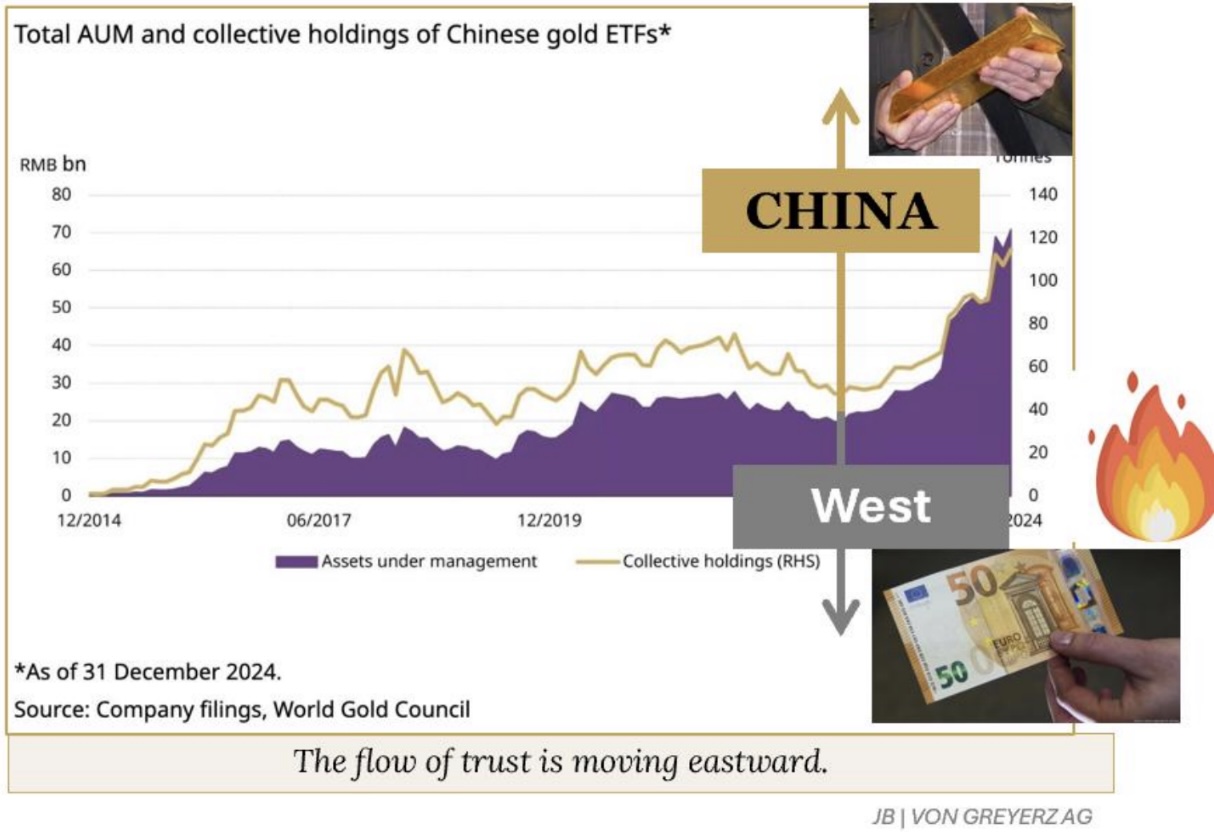
The shift is clear: the East is buying while the West reduces exposure. In China and India, Gold ETF holdings are expanding at record pace. There is a lesson in this patient accumulation: a mindset focused on lasting security rather than short-term noise.
Russian households now own more than 280 tonnes of physical gold, not as speculation, but as protection against currency risk and geopolitical uncertainty.
Unlike financial assets, physical gold carries no counterparty risk, a characteristic that becomes increasingly valuable in periods of monetary stress.
Since 2022, private demand for physical gold in Russia has steadily risen, while Western investors continue to rely mainly on paper exposure. Trust among savers has migrated toward the metal itself.
India, Turkey and several other countries are quietly following the same path.
A Silent Flow of Metal
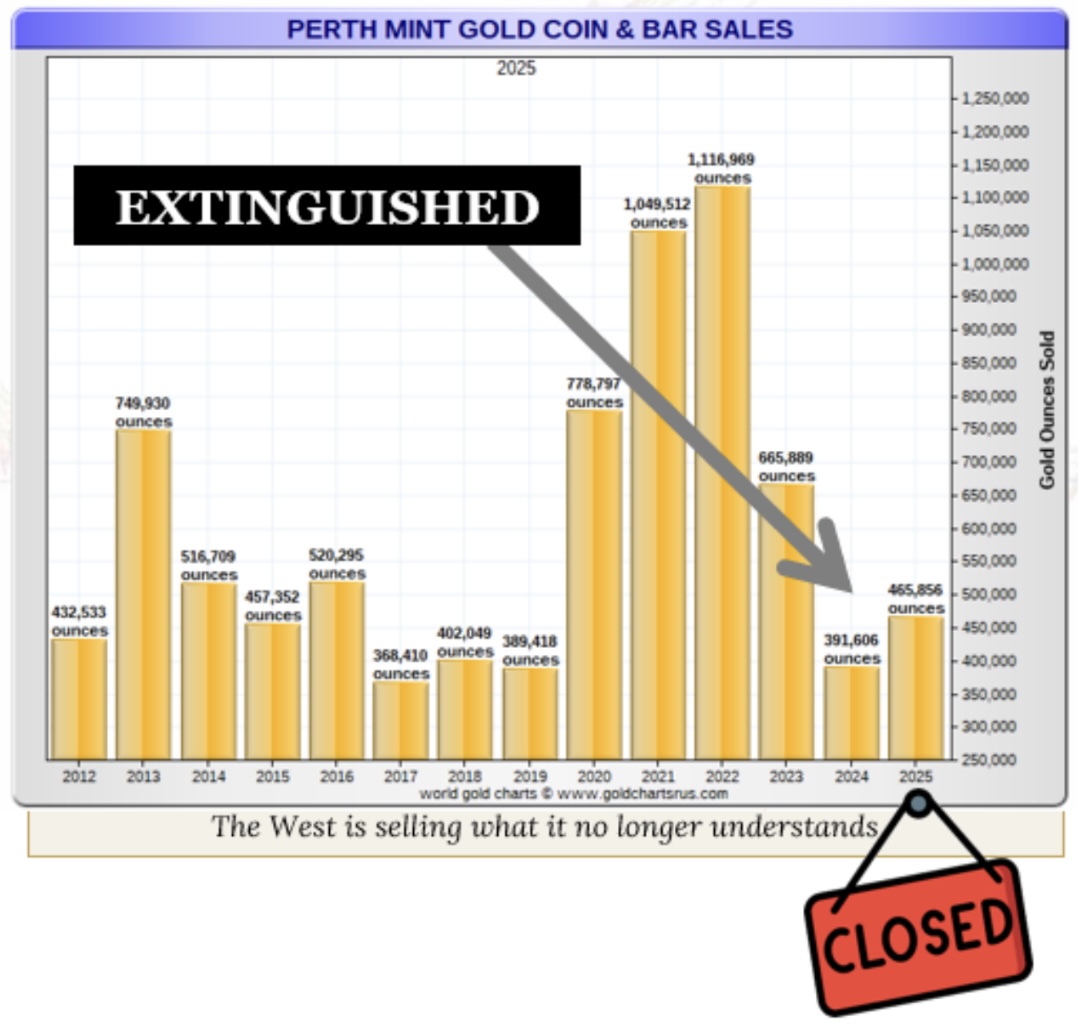
Meanwhile, demand for coins and bars in Western markets fell to multi-year lows last year. Sales data from the Perth Mint, one of the world’s largest sovereign bullion mints, illustrates how sharply Western retail demand has declined.
Gold is moving, not toward where it is most talked about, but toward where it is most understood.
Why Disinterest Is Driving the Price
As Western investors reduce their holdings, more gold moves into stronger hands, tightening the freely available supply. Central banks and Asian buyers are holding firmly to their reserves, while mine production shows little growth.
Prices are rising not because of speculative excess, but because of structural scarcity.
This is not a frenzy, it is a gradual repricing of tangible assets.
Gold’s center of gravity is increasingly shifting toward Shanghai, Istanbul and Moscow rather than Wall Street.
The New Era of Value
We are entering a cycle that central banks cannot fully control. As the East builds reserves and the West continues accumulating debt, global trust is gradually shifting.
In such phases, forecasts matter less than ownership, responsibility and long-term perspective.
Gold is not a trade and not a flight from risk. It represents permanence, a bridge between a fading monetary order and whatever comes next.
Those who wish to preserve purchasing power must own real assets before ownership itself becomes a luxury.
Conclusion for Investors
Gold is rising despite broad indifference. That is not a contradiction, it is the signal. Now may be the time to think beyond financial promises—and consider anchoring wealth in something real, before ownership itself becomes unobtainable. This move is driven less by Western speculation and more by a quiet global realignment. It reflects a return to substance rather than momentum.
In a world increasingly defined by financial promises, direct ownership of tangible assets regains relevance.
Gold is not an escape from the system, it may well be the foundation of the next one.
For investors focused on preserving wealth rather than chasing returns, physical gold remains one of the few assets without counterparty risk. This will link you directly to more fantastic articles from Jan Baltensweiler, Egon von Greyerz, Matthew Piepenburg, and Alasdair Macleod CLICK HERE.
ALSO RELEASED!
Oil Reverses Back Above $103 And Transportation Prices Have Skyrocketed CLICK HERE.
World Economic Breakdown Looms As Countries Run Out of Jet Fuel CLICK HERE.
China Continues Buying Large Amounts Of Gold CLICK HERE.
Despite 2-Week Ceasefire, Europe Faces Long-Term Energy Crisis CLICK HERE.
Iran War And The Big Threat To The US Dollar CLICK HERE.
Underpinning The US Dollar, Plus Almost No Reaction In The US Oil Patch To The Jump In Prices CLICK HERE.
WTI Explodes Higher As Energy Crisis Goes Global, Plus Uranium Coiled To Skyrocket CLICK HERE.
Greyerz – This Is All Playing Out The Way I Predicted It Would For The Past 25 Years CLICK HERE.
Major Financial Storms Are Ahead CLICK HERE.
Colombo Says Past Oil Bull Markets Bullish For Gold & Silver CLICK HERE.
Public Poured A Billion Dollars Into An UltraShort Oil Fund Ahead Of Today’s Rally! CLICK HERE.
Ing Says Gold Price Will Surge Above $6,000 CLICK HERE.
© 2026 by King World News®. All Rights Reserved. This material may not be published, broadcast, rewritten, or redistributed. However, linking directly to the articles is permitted and encouraged.